Paper and Pulp Industries
There is a museum of paper making at The Heron Corn Mill & Museum of Paper Making (c/o Henry Cooke Makin, Waterhouse Mills, Beetham near Millenthorpe LA7 7AR Tel: 015395 63363). More recently a museum has been established at Frogmore Mill, Hertfordshire (this is now a working museum and still has their original Fourdrinier machine in use.
The word paper comes from the Latin 'papyrus', which was a paper used in ancient times, made by pounding the pith of a sedge like plant into sheets. Papyrus is a coarse kind of paper but in 105 AD Ts'ai Lun, an official to the Chinese Imperial Court, reported the invention of paper to the Chinese Emperor. Early Chinese paper was made from bamboo but they went on to develop a paper based on wood pulp, water and straw, this arrived in Europe courtesy of the Moors in about 1100 AD. The earliest record of paper making in the UK is mention of a mill in Hertfordshire in about 1488, but the demand increased steadily over time. The Bank of England has been issuing paper bank notes since the mid 17th century (these have had a water mark on them since the late 17th century). Early paper mills were usually built in river valleys, the river providing both water and power, by the time the railways arrived there were just over 500 paper mills in the UK, mostly small establishments, often converted cotton or wool mills.
Paper can be made from any kind of fibre, including pulped wood, cotton, wool or mashed bamboo. The fibres are mixed with water and spread out to dry, usually with some kind of glue or 'size' added to bind the fibres together. For important documents liable to be repeatedly folded the mix is spread on a woven linen sheet, which bonds to the pulp, this was common certainly into the 1960s (mainly associated with maps).
Prior to the 1860s most paper was made from rags (mainly linen, recycling was once a lot more common than it is today), so mills tended to be close to towns where this material was available and where their products could be sold. The rags could not easily be bleached, so 'white rags' were required, often the waste from weaving mills.
To make paper the rags are ground down and soaked in water, the resulting mess is then poured onto a drying frame where 'sizing' (a form of starch or glue) was added to bind the fibres together. The frame was set aside to dry and the end result is a single sheet of paper. Laying out the pulp on a single wire frame is time and labour intensive and by the early nineteenth century rags were in short supply. By the 1950's traditional hand made rag paper was only used for high quality drawing paper and bank note paper and by the mid 1980s there were only one or two firms in the UK still making paper by hand.
Mechanisation of the paper making process came in the mid 19th century with the development of the Fourdrinier machine. A Frenchman by the name of Nicholas Louis Robert patented a paper making machine in 1799 but was unable to make it work. He sold the drawings to an Englishman called John Gamble in 1801 and they then passed to the brothers Henry and Sealy Fourdrinier, who paid an engineer called Henry Donkin to build the machine and get it to work as intended.
The first successful Fourdrinier machine was set up at Frogmore Paper Mill at Apsley, Herefordshire in 1803 (this was one of many mills converted from flour milling to paper making in the second half of the 18th century).
In 1805, a larger, improved machine was erected at the nearby Two Waters Mill (also owned by the Fourdriniers'), where they had made paper by hand since 1791. Over the next fifty years all the problems were ironed out and other people contributed their own elements to improve the machine.
By the 1820s machines had better drying of the paper and often included a cutter at the end to produce cut sheets rather than a continuous roll.
The principal feature of the Fourdrinier machine is a long continuous belt of wire mesh (replacing the hand-loaded frames), this is housed in a large building (the largest on the site). Early paper mills were often water powered (several early British mills were converted from flour mills) but the increase in demand due to the Industrial Revolution and the introduction of steam power greatly increased production.
There were alternatives, a chap called Dickenson developed a machine which he patented in 1809 which used a brass drum rather than the wire mesh web to pick up the slurry, transferring it to a wet felt pad. Dickinson's machine worked well and quite a few paper mills were set up using it (the last closed in about 1930). Its big selling point was that, as it did not use the wire mesh, the paper was smooth on both sides and well suited to book printing. From the modelers perspective this is an attractive option as the machine, and the building are a lot smaller than for the Fourdrinier design. There is a modern equivalent, based on Dickensons design, usually called a 'cylinder mould' or 'vat machine', which are used for the production of 'boards'.
In the later 19th century (after about 1873) there was a gradual shift to using wood pulp and esparto grass for making paper, not least because of the growing shortage of rags. Thereafter new mills were sited close to the ports where these materials could be imported and during this period a great many of the older small paper mills closed down, with production being concentrated in about 250 larger establishments. In the Canada, the USA and Scandinavia they often have 'integrated' paper mills, taking in the cut timber and making the pulp on site as well as making the paper. In the UK we do not have sufficient forests to do this and mainly rely on imported materials, in the early 20th century there were just four integrated paper mills in the UK (located in Irvine in Scotland, Gwent, Deeside in North Wales and Cumbria), out of a total of about 100 mills in operation.
The most common type of paper today is made from wood pulp, a practice introduced in about 1873, although esparto grass continued to be imported in large quantities until the late 1950s. In 1891 "The Strand Magazine" became the first mass produced, Linotype-set, wood-pulp paper magazine. Aimed at the middle classes it is perhaps best remembered for serialising the Sherlock Holmes stories of Arthur Conan Doyle. The British paper mills generally import the pulp from the Baltic area but also from as far away as Canada. Some wood pulp is produced in the UK, this is discussed below under Pulp Mills.
Although wood pulp paper has dominated the market since the later 19th century there has been a proportion of paper made from recycled waste paper for over a hundred years and rags are still used for some grades of paper. The British Paper Company was established in 1890 specifically to make paper and board from waste paper obtained from organisations such as the Salvation Army and rag-and-bone men.
The Financial Times and the Sporting Pink are printed on pink paper because it was not possible to get a really clean white from recycled paper. In 1921 The British Waste Paper Association was established (initially as the Association of London Waste Paper Merchants) to help develop the trade in waste paper for recycling. Local corporations became involved and by the later 1930s some even operated waste paper trailers which could be towed by their new motorised bin lorries.
At the end of the 20th century British paper production was concentrated in several areas, newsprint was produced in just three mills at Ellesmere Port, on Deeside and in Kent. Writing papers were produced in about 40 mills in Eastern Scotland, the North West of England and in Kent. Tissue papers were being produced by three firms with factories in Kent (notably the giant Bowater Scott mill in Sittingbourne), Sheffield, Manchester and Barrow in Furness. Cardboard and wrapping papers were produced in four main areas, in the South West (Devon and Somerset), West Yorkshire, Manchester and Kent.
Paper Making Process
At the paper mill itself the baled materials was broken up (there are machines for this, called 'bale breakers') and the wood pulp, ground rags or mashed waste paper is mixed with water. The resulting mix (called 'furnish') contains about five percent solids. This is then beaten (in an open drum called a beater) to break up the fibres and produce and even slurry mixture.
The beaten furnish is passed to the Fourdrinier building, as a guide for modelling a typical early machine is about a hundred feet long, about twenty feet high and perhaps twenty feet wide, which sets the size of the building you will need (the largest on the site). The continuous conveyor belt of fine wire mesh has one end dipped into the furnish slurry, which is thus drawn out as a thin layer on the belt called a 'web'. The belt is passed over a perforated hollow roller called a 'couch roll' (pronounced cooch) which has a vacuum pump attached to suck out the water. At the end of the belt the web has dried to form a sheet of rather wet paper. This is then passed between felt covered rollers which squeeze out and absorb most of the remaining water so the web will hold together, and the paper strip is then passed to a series of heated steel drying rollers called a calender. The Fourdrinier machine is fast and often operates for several days at a time, it can produce a range of papers from heavy board to light tissue.
As the paper emerges it can be coated with clay, starch, casein, rosin and wax in various combinations, these being supplied in sacks and barrels (later drums). Expensive 'glossy' paper is made using China clay to give a non-absorbent white finish, this is used where high quality art work is to be printed as the individual dots of ink will not soak into the paper and merge into a blur. This clay was often shipped in white stained wooden barrels but the GWR built end-door wagons with a zinc sheet floor to ship it in bulk and BR built more of these. For cheaper colour printing various forms of 'size' are used.
From the mid 19th century, as printing became the main use for paper, paper makers started to treat paper with alum (actually an alum rosin size, which can be supplied in sacks or drums) to stop ink running during printing. In the 1960s it was found that this caused the paper to (eventually) disintegrate. These days non acidic materials are used, although I am not sure when alum was phased out. Although the alum is being phased out all forms of paper contain some naturally occurring acids which will, eventually, degrade the paper. The original papyrus paper, if kept dry, can last thousands of years.
The final stage is either the cutting to length or, more usually, the formation of a roll. The rolls were, certainly up to the 1940s, between 20 and 84 inches long (51cm to 213cm) and (typically) about 36 inches in diameter. These rolls are normally stored on their ends to avoid deformation, on the railways they were (I believe) carried on end or on their side depending of the 'fit' in the wagon or van. The rolls had a protective covering of thick brown paper, typically with a large white label pasted on to the side. Some rolls have a wooden disc under the wrapping at each end to protect them, others just had an extra wrapping of paper.
There were paper distributors who took in the rolls and cut the paper to suit clients requirements, selling the cut paper to shops and larger customers (institutions, printers and the like).
The paper mills use a lot of water (they are virtually all located beside a river), although a lot of the water is recycled a modern mill still uses something like 100 cubic metres of water per ton of paper produced. The river water has to be purified for use, and for this chlorine, in the form of chlorine dioxide, is still a preferred option to kill any organisms it contains. The water is usually passed to settling thanks where the suspended solids are allowed to settle out, the water may then be passed through filter beds and they may have to use chemicals to combine with the impurities (forming a foam which floats to the top and is skimmed off).
Water being returned to the system has to be treated, since the 1970s this has involved settling tanks and filter beds to remove any solids before discharge. Some plants were using centrifugal cleaning systems to remove suspended solids by the 1990s.
The remaining wastes are mainly a non toxic sludge, some of which was dried and used as fuel for the boilers, the rest being dumped. The solid wastes from the mill can contain harmful chlorine related compounds from the bleaching process, but these days they mix in lime and add micro organisms to treat this stuff.
Paper making takes a lot of energy and the mills used a lot of coal, or from the 1970s oil (oil was the most common fuel used in the 1990s), hence at least one of the very tall chimneys associated with these works. As they make a lot of steam they often have their own steam generators.
By the outbreak of World War Two there were about two hundred mills in the UK, by the 1980s this had dropped to about 100 (I believe this figure has since remained stable).
Modelling the paper industry
Paper factories are usually quite large establishments, so again for a modern (post 1920s) paper mill we must depict just one part of the works, the remainder being on the backscene. As noted above paper mills were (and are) built beside rivers in order to use water power and for supplies of water used in the process. Up to the early 20th century there quite a few fairly small mills set up, often these were converted flour, cotton or wool mills. Several of these small mills continued operating into the 1930s, however from the later 1920s paper mills tended to be large. For a layout we can stretch things a bit and have one of these smaller mills, perhaps producing specialist papers, still operating into the late 1930s, even into the early BR period. To justify things being as small as possible you might even suggest it uses a Dickenson cylinder mould type machine.
Paper mills were located outside the built up areas but needed access to the towns to sell their products. In the early days the rivers and canals were also the main means of transport, so a quay or wharf was often a feature of the mill (many had passages running underneath the mill for barges to load and unload under cover).
Paper makers were early adopters of steam power, so tall chimneys (or a few in larger mills) were a characteristic feature, even for mills equipped with a water wheel. Roof ventilators also seem to have proliferated on paper mills, so you will need a few of these on almost any mill.
The example shown below is based on a photograph of a paper mill in the south of England in the mid 19th century and has all the features common to paper mills of the time. This mill is built beside a river, not on a canal, the mill required a head of water so they built weirs and to allow barges to pass they had to build locks as well. I have reduced the width of the main building and the extension over the wheel by about a third, and generally compressed the scene, but it retains the character of the prototype.

The paper mill sketched below is based on a picture from the 1800s showing Joys paper mill in Belfast. The very large windows make it appear compact but it was a pretty big building, the small figure in the bottom right is a man with horse and cart and the water wheel is over fifteen feet in diameter. In N (1:148) the building would be about four and a half inches tall (11.5cm) and the big chimney would be nearly six inches (15cm) tall, the building does have a certain character however and serves well as the basis for a model.
By combining aspects of both and rearranging things a little we can have a pleasant rural industrial scene on a layout, with the additional scenic benefit of one or two road and rail bridges over the river thrown in. Small mills of this type were rare by the early 20th century, but for modelling purposes you could stretch it into the 1930s.
In the sketch below I have assumed the main building is constructed in a line, not as the front and rear parts on the original. I reduced the height of the left hand end of the building (this saves a lot of windows), however the buildings still have all the necessary attributes. I have moved the barge access tunnels onto an extension of the main building (as this can be set back to give more room for the barge access route), the tunnels have been narrowed and will now only take a narrow barge. I have added a sack lift to the bay section on the main building with a substantial crane mounted on the corner to handle the heavy bales of pulp.
Fig ___ Large flour mill converted to a paper mill
If you assume that the original mill has been extended, perhaps as part of its conversion to paper making, or just for an expansion of the business, the extension on the left need not match the main building. In the track plan shown below the road bridge serves to hide the join of the river with the backscene. The canal side pub and general stores is optional. No crane is shown on the plan, however I would expect one to be available to handle the bales of pulp.
This layout can be compressed, you need a minimum of 15 inches plus the length of the rake of wagons (uncoupling is best done on the straight siding, not on the curve), so with British four-wheelers if you only ran in four wagons and vans it would fit in a two foot length (60cm).
If space is tight we can skip the barge access tunnels, on the plan as shown below the original railway bridge is brick but the siding uses either a timber or (more likely) a plate girder bridge. The hump-backed road and road bridge over the river at the rear again helps disguise the join with the backscene, the road is wider than the bridge, which is only one car wide, this is typical of more rural river bridges.
The increasing use of imported materials lead to large works being built near docks or on river estuaries where they could set up their own quay for sea going ships (one notable example being the giant Bowaters factory at Sittingbourne in Kent). However smaller inland paper mills remained in operation, at least into the 1980s. Smaller however does not mean small, I have yet to find a post 1920s paper mill that was not a very large establishment, the example below dates from the 1920s and is a typical size for a 'smaller' paper and board mill. The mill has its own dock, on the extreme right, and it was close enough to the sea for coastal vessels and 'short sea trading' ships to deliver the pulp from the continent. The actual mill was in a fairly built up industrial area, I have shown the surrounding land as pasture for clarity.
Do remember that paper mills are built alongside rivers, which they use for their water supply in the processing of the pulp, a river is not shown on the plans below but there should be one very close by.
The suggested buildings shown below are about as small as you can go for a post war paper mill. The illustration is made up of elements of several mills, the left hand end is based on a compressed version of the mill in Musselburgh (closed in 1971). Adding a second siding would be an advantage, to handle the block trains of pulp arriving from the docks. The siding(s) should be inset and run alongside the building, accessed from the three red doors on the side, or by fork lift truck in the yard area.
The track plan shows some silver tanks on the site, accessed via the kick-back siding, these were (I believe) only found where wood is being processed to make the pulp on site (that is only in larger 'integrated' works, rare in Britain), however from the later 1960s they may have been used for china clay slurry and they add interest to the scene. By the 1980s most paper mills used oil for heating the process, so for air braked 'Speedlink' era service fuel oil tanks storage should be included in this area.
The suggestion above really is a bit small for a paper mill, even on a model railway. The 'margarine works' shown below (from Coastal and Riverside Industries - Margarine, Soap and Detergents) would make a reasonable basis for a paper mill on a post mid 1920s layout (the section of building on the right is based on an American paper mill). Replacing the covered platforms at the left hand end of the layout with another large building would be the only change required.
Fig ___ The suggested Margarine works building
As noted earlier tall chimneys are a feature of paper mills, the example below is a sketch of the mill at Musselburgh, from a photo taken (I think) in the 1960s, the chimney is something over 120 ft tall (over 30m).
This building could be incorporated into the Margarine works buildings as shown below for a paper mill built from the mid 1930s on. In the sketch I have used large windows (of the type used for engine sheds) for the concrete buildings on the right (you could use Peco, Doiwnsglaze etc). This means you have fewer windows to cut in the building. I have shown oil tanks beside the boiler building, this would be appropriate for a works built from the later 1930s, however if you have a lot of coal wagons you could replace the tanks with a coal heap. The remainder of the right hand area could be given over to delivery lorries or a staff car park (for post 1960s layouts), the corrugated roof building in the bottom right of the site plan is a bike shed.
Fig ___ Suggested large paper mill main buildings and layout
There are two sidings, so the works can accept full block trains of pulp arriving from the docks. The cross-over (shown dotted) does allow shunting the works lines for access to the 'finished goods loading bay' at the left but it is not essential and as the track should be inset this is (I feel) best eliminated for this type of works. The gantry crane is in the centre of the sidings so should be clear of your hands in the event of coupling problems when shunting, the smaller crane shown on the loading platform to the left is for lifting rolls of paper into railway wagons (or road vehicles).
Paper works would receive wood pulp, shipped compressed into in sheet form and bound into large bales, in the 1930s these were about two feet square and five feet long (60 x 60 x 150 cm) and weighing about 450 pounds (roughly 200 kg) each. Entire train loads were the norm and when a particularly large shipment arrived the sidings in the local area would often be filled with sheeted open wagons waiting to be emptied at the mill. This raw material, unprocessed, is used for newspaper and cheap 'Manila' papers.
Finding details on these bales has proved difficult, in the 1930s the US was exporting large bales as shown below, the pulp was folded like blankets, wrapped (possibly in thick brown paper), compressed and banded (although the banding seems to have been very light. The bales would damage easily with handling so the ends and sometimes the sides, could be quite ragged. The illustrations below are based on photographs of American stevedores handling a ship load of pulp for export in 1939 (there were groups of three or four men handling the bales, so a crane at a paper factory seems highly likely).

The pulp is either white (bleached, above right) or the colour of the lighter side of brown paper(unbleached, above left), but I understand it was given an out wrapper of strong brown paper to help hold it together.
By the 1960s pulp was a lot more compressed, formed into blocks and often shipped on pallets for fork lift handling. These newer bales are too big for a man to carry, about four feet cube with two bands round them and wrapped in a white covering (these days it's plastic). Talking to a chap who worked in a paper mill in the 1960s he said the pulp came out of the bales in blocks 'like telephone directories'.
Specialised papers are made from materials such as bamboo, flax, jute and esparto grass. This latter was regularly used for paper making from the 1860s until the later 1950s. Esparto grass is grown in the Mediterranean area and produces a high quality paper suitable for intaglio colour printing. Intaglio printing allowed 'colour plates' to be printed (albeit with difficulty and at high cost), it was developed in the 17th century. The grass was initially imported loose and shipped inland in sheeted open wagons where it formed a bulky load similar to hay, by the 1930s it was usually baled, although the bales were not compact and tended to fall apart during handling.
Bales of African esparto grass (late 1930s)
Up to the 1970s (possibly later) Jute arrived in bales, 6 foot (1.8m) long by 3 foot (1m) square (larger than most other bales, eight of these weighed in at about a ton) and secured with 'iron' (probably steel) bands.
Rags were supplied bales, most seem to have been tightly bound and resembled bales of cotton, but some was shipped in large rectangular bales anything up to four foot (1.2 m) square by three foot (1 m) high, often with scraps of material poking out along the corners.
Fig ___ Bales of rags
To put a smooth or gloss coating on the paper they also use quantities of China clay, originally carried in privately owned low-sided open wagons but subsequently shifted in barrels. The GWR built a fleet of five plank end door wagons for china clay traffic and further examples were built by BR (the 'clay hood' wagons), these travelled the country up to the early 1960's. Since the 60's the clay has mainly been shipped 'wet' as a slurry in tank wagons but the five plank wagons continued in use until 1988 serving the ports of Fowey and Par in Cornwall.
Traffic out of a larger mill would consist in the main of rolls of paper and card ready for machine cutting or printing, although some might be cut down to sheets for a particular client. Rolls of paper were between 20 and 84 inches long (51cm to 213cm) and (typically) about 36 inches in diameter, wrapped in thick brown paper. In the illustrations below the chap on the left is standing next to some rolls of news print, wrapped ready for shipping, the rolls shown being moved on the right are for use in other industries.
Fig___ Typical paper rolls

The paper rolls were often just rolled along the ground (with their outer wrapping of thick brown paper), this was common in smaller docks handling occasional shipment of paper. In the early 21st century there are firms offering powered roll pushing machines, essentially a powered wheeled base with a roller on the front and a long handle for the operator. This is pushed up against the roll of paper and pushes it along the floor, the powered roller on the front of the machine ensuring it rolls and doesn't just slide along.
Thin card for making single-walled cartons was also shipped out in rolls, typically about four feet (120cm) in diameter and about three feet (93cm) wide (each one weighing in at about 11 hundredweight, hence the machines used to shift them). These could be loaded directly onto the printing machines at the carton making works. This type of carton was used for selling everything from cigarettes to boot polish, so there is no problem proposing a client for the traffic. The sketch below is based on a photograph of a roll being loaded onto a printing machine at the receiving end and gives a sense of the scale of the rolls.
Fig___ Roll of carton card being loaded into a printing machine
Heavier card, used for making the boxes to ship the cartons in, was usually supplied from the paper mill in flat form, rough cut to measurements given by the client. It was typically delivered in half-hundredweight bundles (at one firm, making shoe polish, the largest size used in the 1950s was 47 inches by 35 1/2 inches).
Smaller mills would send out rolls to distributors who cut the paper or card to clients requirements and rolls of kraft paper to sack makers but I understand that the bulk of the output from smaller mills would be guillotined, wrapped in 'reams' of 500 sheets and shipped out in wooden cases. By the 1960s a lot was shipped in cardboard boxes, each holding perhaps five reams of wrapped paper (typically A4 size by about a foot (30cm) deep) and strapped to pallets.
As noted above the paper mills tend to be large establishments, some of which (notably the large Bowater's factory at Sittingbourne in Kent) had their own narrow-gauge railway systems for moving the pulp bales and finished paper rolls.
The steam locomotives were often fitted with 'spark arrestors' on the chimney (diamond shaped extensions, as seen on early American locomotives).
Fig___ Narrow gauge paper mill engine with 'spark arrestor'
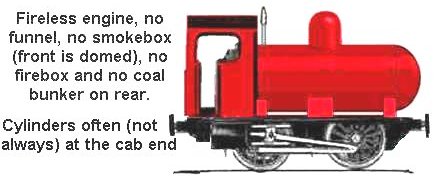
In more hazardous areas they also sometimes used 'fire-less' steam locomotives which were charged with steam at a boiler house some distance from the flammable paper products. These locomotives usually had 'domed' fronts to their 'boilers' and the cylinders were often at the rear, under the cab footplate, the exhaust (not a chimney) was often on the rear of the cab. Using Z gauge locomotives and track it would be possible to add such a system, leaving the main works as part of the back scene.
Fig___ Typical 'fireless' engine
Paper works were at the forefront of recovering waste heat from chimneys, using a device called an 'economiser' which is in effect a boiler fitted into the base of the chimney. Up to 30% of the heat can be recovered in this way, resulting in a 30% saving in fuel costs.
Paper sacks
The multi-wall paper sack, so much a feature of modern life, was first produced in Britain by Colthrop Board & Paper Mills Ltd (later trading as Medway Sacks) of Aylesford in 1929, following the development of Kraft paper. Initially sold under the brand name 'Satchelsac' they were used for what were termed 'rock products'; cement, lime and plaster.
In 1933 a form of creped Kraft paper was developed which allowed the development of paper sacks for animal feed-stuffs (sold as 'Crepesacs'), which received a Gold Medal from the Royal Institute of Hygiene.
The range of materials supplied in paper sacks continues to grow today, in the mid 1980s there were over 5,000 separate designs produced by Medway Sacks alone (the Paper Sack Development Association actually produces a 100 page users guide on the subject).
Larger users such as cement firms might well produce their own sacks from rolls of multi-layer paper. The rolls of paper are some four or five feet in diameter and about five or six feet wide, generally coloured pale brown. This is fed into a machine which prints the logo and then forms the paper into a gummed tube. One end is closed off, originally by sewing, these days by folding and gluing, and the sacks are passed to the filling plant where they are filled with pre-weighed quantities and sealed by automatic machines.
From the modellers point of view there are two main points to note regarding paper sacks - Firstly paper sacks were initially used with the open end tied off not sewn, although the resulting package was squared off with well defined 'shoulders'. These sacks continued in use for some products into the 1950's (to produce these add a small blob of Milliput or similar modelling clay to the centre of one end of a whitemetal sack). Secondly two colour printing of sacks was only introduced after the second world war, some time in the early 1950's.
The now common 56 lb (25 Kg) paper sack was introduced during the Second World War for dense materials such as cement, replacing a 1 cwt (hundredweight or 51 Kg) type which was considered too heavy for the women working in the factories.
The sketches of paper cement sacks below are based on my own and other peoples memories and may be inaccurate, however they are close enough to pass muster. Up until the 1950s paper sacks were almost all printed with a single colour, two and three colour printing became more common from the early 1960s. The CMC inside the circle was replaced by Blue Circle in the mid 1960s, the plain blue ring came in (I think) in the later 1980's or early 1990s (I understand the company name actually changed from CMC to Blue Circle in about 1995).
Paper Cement Sacks
Pulp Mills
Pulp is mashed up trees, for paper making the best are spruce, pine, fir, larch and hemlock which have long fibres suited to making paper. Hard woods such as eucalyptus, aspen and birch are also used, mainly for newsprint and cardboard making. The problem lies in the nature of the wood, which consists of three separate parts, cellulose (the bit you need for paper making), lignin (a fibrous material that helps plant stand up) and a small quantity of binding material and you need to break these up to make paper.
The use of wood pulp for paper making began in Germany in the early 19th century, the pulp was made by mechanically grinding up the wood using sandstone grinding wheels similar to those used in flour mills. By the later 19th century there were also chemical processes being developed to break down the wood, based on sulfurous acid or calcium bisulfite, the first commercial mill producing 'sulfite wood pulp' was built in Sweden in the 1870s.
Pulp mills take in lengths of timber called 'pulp wood', these logs resemble pit props with diameters ranging from about three inches (8 cm) to ten inches (25 cm). They are shipped in already cut to a length to suit the mill but usually in the range three foot six inches (1 m) to seven feet (3 m). At the mill the logs are stacked in the open, fairly neatly, in large stockpiles.
Most mills accept logs with the bark still in place, which they remove using mechanical de-barking machinery, the bark is then used as fuel in the boilers or (more recently) bagged and sold for gardens and public parks.
The logs are then 'chipped' ready for use, the chipped wood is stored in heaps under cover.
There are four kinds of wood pulp used in paper manufacture, all are made from trees but the difference lies in the way they are processed.
Wood which has simply been ground up and not chemically treated, commonly called mechanical pulp, is used for newsprint and cheaper Manila papers. The bale of pulp is chopped into fibres and placed in a tank where it is soaked in a water and bleach mix to separate the cellulose from the unwanted lignin, at this stage dyes may be added to give coloured papers. Early mechanical pulp mills used sandstone grinding roller, replaced in the 1940s by manufactured grinding 'stones' with embedded abrasives such as silicon carbide. Mechanical grinding takes a lot of energy, breaks up the fibres more and leaves a lot of lignin in the pulp, so although it produces nearly twice as much pulp than chemical processing the paper is not as strong and the residual lignin turns the paper yellow with exposure to oxygen. On the plus side it is cheaper than chemical pulping and the material is used for newsprint and cheaper paperback books.
Soda process pulp is made by allowing caustic soda to break down the wood, usually used with Poplar wood.
In the 1920's a firm called A.E.Reed & Co (now Reed International) developed a new kind of strong paper they called Kraft. Kraft paper is produced by adding sodium sulphate to the normal caustic mix used to break down the wood. The resulting paper is stronger than other types as the fibres are less damaged, but it is less easy to bleach to produce white paper. (the Kraft process has not been used in the UK since the mid 1990s).
Sulfite process pulp (a form of kraft paper) is associated with spruce and other conifers, in this the wood chips are digested by a mixture containing magnesium, ammonium or calcium disulfite containing free sulphur dioxide. This process is used at one of the four combined paper and pulp mills in the UK (the rest use mechanical pulping).
Sulfite and sulphate comprise the bulk of modern wood pulps, unbleached they are used for brown wrapping paper and the making of cardboard. In both the wood chips are dropped into a large cylindrical chamber, roughly five feet in diameter by about twenty feet long, called a 'digester', In this tank they are steam heated, pressurised and treated with the alkaline (kraft) or acidic (sulfite) chemicals to break apart the lignin and cellulose. The result is a thick sludge which is allowed to exit the digester via an orifice, the sudden drop in pressure further separating the fibres.
The resulting liquid is then washed to extract the cellulose pulp, the residue was for many years simply waste, requiring constant supplies of chemicals to keep the plant going. A chap called G. H Tomlinson developed a method of recovering the chemicals used (in a 'recovery boiler', these days known as a process recovery boiler) and kraft paper became very economic to produce.
The pulp meanwhile is pumped into a large storage tank as 'unbleached pulp', this can be used to make brown paper or cardboard. The pulp is run through something a bit like the Fourdrinier machine where it is spread on a wire mesh which carries it between rollers to squeeze out and drain the remaining water.
The pulp may then be bleached for making white paper, otherwise it is used for cardboard or brown wrapping paper. The bleach used was originally chlorine bleach (I believe this was chlorine hypochlorite, supplied in white-stained wooden casks about the size of hogsheads). It has been suggested that some works used chlorine gas (another use for those hutched tank wagons) but this seems a very risky approach. All the older chlorine bleaches used left a lot of chlorine in the effluent from the mills and (since about the 1970s) chlorine dioxide has become the most common medium. Normally this is a pale green and deadly gas but it can be refrigerated to produce orange coloured crystals, I understand that larger mills produce it on site as it is unstable and hard to transport.
When produced the pulp is a fluffy material, for paper making the pulp is compressed into thick sheets (to get a solids content of about 90 percent) for transport to the paper mill (known as 'market pulp'). The pulp can also be sold as 'fluff pulp' for making absorbent products (such as disposable nappies), by the 1970 and 80s this pulp was supplied compressed into something resembling thick card about 2mm thick rolled onto a spool about four feet in diameter and two feet six inches in diameter (see the illustration above 'Roll of carton card being loaded into a printing machine'). They arrived on their sides, stacked two on a pallet. The coil of pulp was lifted with slings of canvas, two strips each about about nine inches wide becanse the roll was slotted onto a spindle fixed to the machine. The machine itself was housed in a concrete bunker which had a weak roof, so if there was a dust explosion the blast would go vertically, blowing the roof off, and not damage surrounding buildings or people.
Recycled paper constitutes a significant source of pulp, the newspaper printers recover and sell their unsold papers for recycling. The paper has to be cleaned to remove any inks or other contaminants and the paper is then re-pulped in water. The material may be bleached for making white paper goods, chlorine is seldom used today, the preferred alternative being sodium hydroxide and sodium silicate. The result is known variously as de inked fibre (DIF) and Recycled Fibre (RCF).
There are a lot of chemicals associated with the manufacture of wood pulp, bleaching agents, various glues and sizes, coatings such as china clay (for glossy paper) and dyes (for coloured papers. Most of these used to be delivered in drums but by the later 1980s there was a move toward shipping in bulk, often as a slurry (one example being china clay tankers). Bulk storage means the mixing can be done automatically using pipework, reducing the manpower and also the spillage and errors associated with the drums.
Starch is used as a 'size', this used to arrive in sacks or drums but since the 1990s it has been stored in large silos.
Most British paper uses imported wood pulp although some wood is pulped in this country, there were wood pulping companies operating in the UK before World War One. The railway wagons used have been many and varied, originally standard open wagon types (generally long wheelbase) were used, after World War Two BR built the vacuum braked Timber P wagons using redundant plate wagons chassis. In the early air braked era standard BR air braked opens were used and these were joined in the 1980s by the air braked OTA wagons (most built on redundant van chassis).
The wagons are typically unloaded by a traveling gantry crane, at one establishment this had one rail on the eaves of a large metal building, the space between the siding and the building is about that required for one track width (two inches would be fine for N). This makes a pleasingly compact option for a model scene.
Three of the four combined pulp and paper mills in the UK use the mechanical pulping process, and hence have only a few storage tanks on the site. The layout below has the essential features for a post war mill, other than a tall cylindrical concrete chimney, you will need to fit that in somewhere, possibly from the roof of the concrete building in the centre.
On the far left is the loading bay for sending out the pump bales, to the right of this is a large featureless building clad in pale metal sheeting, in the centre is a concrete building to the right of which is a long low building along which the gantry crane runs. The crane has a drivers cab suspended from the gantry at the building end. On the right are a small building with a tallish metal chimney and some tanks for the chemicals used. Dominating the right hand end is the stockpile of cut logs ready to be processed.
Fig ___ Post World War Two Pulp Mill for a Layout
The crossover (shown dotted) is not essential but it does allow a train arriving from the right to run round its rake of wagons.
The scale of the log stockpile is hard to get across, it really does dominate the area and the example shown above is really as small as you can go. You need an awful lot of 'logs' laid in neat rows, nothing longer than about half an inch (13mm). The logs are all fairly straight, they are cut from pine trees in the UK. However you can make a simple box as shown below for the main body of the pile, I would suggest corrugated cardboard profiles with strips of postcard across these to form the base. You then need to spend some time collecting lots of very small fairly straight twigs to clad this with, to get the bulk required you can mix in painted cut down lengths of micro rod. If you get the brownish coloured stuff you can paint the rod then cut lengths from it.
For the sides of the piles just cutting lots of short lengths to glue on is a bit mind boggling, a better option is to prepare a small section of 'ends' and press down some scraps of kitchen foil over this, gluing the pieces of foil to the sides of the pile with Uhu or similar. When the glue has set solid paint the surface brown, then stipple this with spots of pale cream to highlight the 'bumps' representing the cut ends. For OO scale you can use cocktail sticks, and I have had some success using spaghetti (easier to cut to length without shattering if you dampen it first), but in N both of these are right at the upper limit of the allowable size.
Traffic out would be sheeted opens carrying the bales of pulp, and also vans of bagged bark chipping for sale to gardeners and the like (sawdust and the bulk of the bark is used as fuel in the boilers).
Waste material recovered from the processing of the pulp (specifically calcium carbonate) is used as a fertiliser, however I have not been able to find any further information on this traffic from the mills.
Along with the brick works the pulp industry was an early adopter of the lorry mounted hydraulic crane, enabling the lorry to load and unload itself. These were common by the 1960s and not too difficult to model using something like the Dornaplas Ford truck as a basis. The lorries used, as with the railway wagons, have raised stakes along the sides of the flat bed to hold the load. In the 1950s and 60s articulated lorries were widely used, so the tractor unit could be off for another load as the trailer was being loaded or unloaded, the trailers used were flat beds with stakes along the sides and the tractor units had cabs similar to the truck shown below left. By the later 1960s they had modified large fork lift trucks, the modern example shown below right dates from about 2005.
The log handling cranes are a more difficult proposition to model, you can buy them for OO but not (as far as I know) for N Gauge.
It takes 16 trees to make enough wood pulp to produce 1 tonne of paper. The consumption of paper in the UK has risen consistently over the years, in the 1990's the average family of four was throwing away about 6 trees worth a year (although the UK is the most wasteful country in Europe in this respect).
British Paper and Board Manufacturers
There are still a large number of paper making companies operating in the UK, I have a list of over 120 firms from my research in the 1980s, however many are users of card and paper rather than manufacturers and I am still sorting through to identify who does what.
Regarding paper and board manufacturers in the UK I believe Medway Sacks closed in 2003.
Bowaters
Bowaters were originally a paper wholesalers, supplying newsprint to the papers in London. Besides wholesaling and agency activities, during the Edwardian era the company moved into large-scale dealing in wastepaper, including the export of surplus newspapers to the Far East, where they were used for the protection of young tea plants. They bought up the pulp mills in Newfoundland and expanded into the USA. They entered the paper making business in the 1920s (they purchased the site at Northfleet before the First World War but it was the 1925 before the factory went into production. They built a large mill on the Mersey near Liverpool in about 1930. In 1936 they purchased two existing paper mills at Sittingbourne and Kemsley. In World War Two the Northfleet mill closed down for a time but the firm purchased the Acme Corrugated Cases Company in 1944 and in 1947 the name changed to Bowater Paper Corporation. By this time they were the largest paper maker in the world. In the mid 1950s Bowater-Scott Corporation was formed to make paper tissues (Scott being the American firm holding the vital patents). In the 1960s and 1970s the firm had to reduce in size dramatically as there was an over capacity in the world paper supply, in the early 1970s the Northfleet mill was closed and the land sold off.
The UK tissues business of Bowater Scott was taken over by the Scott Paper Group in the mid 1980s (Kimberly-Clark Corporation bought out the company in 1995 but production continues at the Kent factory today). In the later 1980s there was a major restructuring and the name changed again to Bowater Industries plc. Bowaters plant at Sittingbourne was sold to a Finnish company, however the plant closed down in the early 21st century. In 1990 Bowaters took over Norton Opax PLC (printers and publishers) and another name change to Bowater PLC then in 1995 The Company changed its name to Rexam PLC.
Inveresk Paper Company Ltd
The Inveresk Paper Company Ltd was incorporated in 1922 in Musselburgh, Scotland, as a vehicle to bring together a number of independent paper mills. The company was noted for the manufacture of strong ply sacks used to transport commodities such as tea, flour, sugar, potatoes, chemicals and minerals. Paper Sacks, part of the Dickenson Robinson Group, acquired the company in the early 1970s. The Swedish packaging company Korsnas in turn, acquired DRG in 1988.
^
Go to top of page