Introduction to Line-side industrial premises
and associated rail connections
The railways were primarily built to serve industry and as recently as the 1960s access to the railway was important to even quite small scale manufacturing and retailing. In the 1990s, even after the various governments have tinkered with the railway services, a rail connection is still very important to most of the heavier industries. From a model railway perspective line-side industrial premises are useful as they generate traffic for the line and may also entail special workings to and from their sidings. The modelling possibilities are also attractive, industrial premises evolve over time, buildings are added and removed, windows are bricked up and new holes put through walls, the detailing of an industrial structure can be most enjoyable.
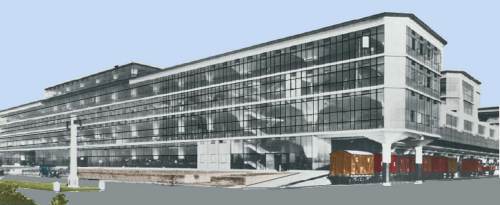
Although primarily associated with heavy industry the fact is that up to the 1950s any factory with a substantial output would have a private siding, the example shown below is the Boots the Chemists 'wets' factory in Nottingham, built in 1933, note the siding run along the right hand end of the building where a rake of vans and an open wagon are being dealt with. It is also worth noting that this glass and concrete building is a fairly typical factory of the time, firms dealing in chemicals, light engineering or electrical goods might all use such a building where plenty of light was an advantage to the work being done.
Fig___ Boots pharmaceuticals factory 1933
The wealth of Britain has been built on three primary industries; mining, textiles and engineering. Metal mining dates back thousands of years, textiles became important by the end of the sixteenth century and engineering developed with the coming of the Industrial Revolution in the early nineteenth century. Prior to the Industrial Revolution most of the population lived on the plains in the south and east of the country and along the coasts, London was the most significant port with Bristol a close second. The new industries, and of course the railways and steam powered ships, depended to a large extent upon coal for power. As most of the coal is to the north and west of the country there was a general migration in this direction from the late seventeenth century.
Britain has been an important metal mining country for over five thousand years, tin and copper mining brought trade with Eastern Mediterranean countries but there was some considerable gap before British iron was mined and lead became important after that. It was the mines that originally developed railways, initially using wooden rails, and once coal became the standard fuel the movement of metal ores from the mines to the smelters became a regular traffic for the railways. As recently as the 1960s the vast bulk of British steel was made using British ores, only with the development of very large bulk carrying ships in the 1970s did imported coal and ore become economically viable.
By the time the railways appeared coal was by far the most important mineral in terms of the sheer quantity moved. Coal gained economic importance in the fifteenth century, when wood become scarce as the human population grew and the forests were cut down. The development of coke was important to the development of iron making and the by-products produced laid the foundations for the chemical industry. The importance of coal and mineral mining in the early history of the railways left the legacy of the somewhat restricted British railway loading gauge. Coal remains today the single most important source of power in Britain, although over the years the uses changed from fuelling boilers and supplying domestic fires and cooking stoves or 'ranges' to the generation of 'town gas' and electricity. The development of oil engines in the later nineteenth century, and the discovery of large oil fields around the world saw coal fall from favour as a fuel however as the oil fields are depleted the cost of making liquid fuel from coal may well see a resurgence in its importance. Coal was mined mainly to the north and west of England, south Wales and the southern part of Scotland and most heavier industries up to the late 1960s were centred on these coal fields. A map of the main coal fields, with notes on their associated industries, is included in the subsection dealing with coal mining. A lot of coal was shipped round the coasts by sea and many early railways were built to get the coal from the mines to the coaling ports on the coast. As the railways developed it became increasingly practical to move the coal by rail and as a lot of the major industrial users set up shop close by their nearest coal field long rakes of coal wagons became a feature of the British railway system.
The next great industry was textiles, although until the end of the eighteenth century most of the work was done at home. Wool had been important for hundreds of years and the industrial revolution began as the mechanisation of this industry. The woollen industry was spread all over the country but with the development of powered machines the new large mills in the South Riding of Yorkshire came to dominate. After about 1800 cotton also became increasingly developed and eventually transcended woollen's in importance, the cotton industry settled in Lancashire where the Wool Guilds were not so strong. The impact of industrialiasation is illustrated by the fact that by the mid nineteenth century Lancashire cotton was clothing almost half of the worlds population. Many cotton mills were built before and during the very early years of the railways expansion, so most had no direct rail connection, they relied on the local goods yard and fleets of horse drawn waggons (later steam and oil engined lorries)for delivery and collection.
The third primary industry was engineering, built on a foundation of coal and metals from the mines and driven by the need for equipment for the mills and factories. This in turn allowed the development of more sophisticated farm equipment, whilst the railways prompted the development of heavier engineering, which in turn lead to the development of the British ship building industry. The evolution of these industries meant that new factories were built, many with a direct railway connection to allow the large quantities of raw materials and the often bulky and heavy finished goods to be easily transported.
The new industrial centres and the wealth they created allowed the development of peripheral industries, woollen spinners became carpet makers, tin smiths turned to making decorative biscuit tins, and the growing densely populated conurbations allowed the economic use of public transport. The demands of the textile industry coupled with the availability of coal tar from coke works allowed the development of a sophisticated chemical industry. Ports such as Glasgow, Liverpool, Middlesborough and Hull all grew in importance as British industry began to supply the world with machines and manufactured goods. This allowed the development of trade with other countries, due to the Empire this was often on favourable terms to the British, and that in turn supported the British ship building and ship owning industries. As recently as the 1960s over twenty percent of all the worlds ships were British owned, and anyone using these ships paid their bills in British ports such as London and Liverpool.
The railways were essential, almost all long distance haulage was by rail as the roads were not up to the job of handling heavy traffic and road vehicles were limited in their capacity (a big steam lorry might carry one and a half tons at a maximum speed of 20mph).
Most heavy industry, working with iron and steel, settled on the large coal fields to either side of the Pennine chain, around Durham in Northumberland and in the south of Wales. There were exceptions, for example there is no coal in Barrow in Furness, and coals from the nearby Cumbrian coal field are of poor quality, but the dark brown Hematite iron ore in the area was amongst the best available in Britain. In this case it was worth transporting the coal and coke to the iron works and the iron industry in Barrow enabled the establishment of ship building, which kept going when the ore began to run out. In the first half of the twentieth century the shift to electrical power allowed the development of light engineering in areas which did not have their own coal reserves, notably the South East of England with London and Southampton as the main ports. One small point is that fluorescent lighting was introduced in 1933, originally confined to the interior lighting within a decade it was occasionally seen on external lights as well.
Looking at old maps you may be surprised to find just how much industry was located inside the boundaries of the towns and cities. Most of this industry was comprised of small firms operating from workshops and factories often no larger than a typical house. Up to the nineteenth century many people worked from home and their houses were often built to suit this kind of work, good examples being the lace makers houses in Nottingham which feature a third floor fitted with large windows, and the chain and nail makers houses to the North of Birmingham with their small workshops built on at the rear. The scale and importance of this kind of industry can be judged by the various Acts of Parliament introduced to regulate the working conditions of the people involved.
In 1909 Winston Churchill, then head of the Board of Trade, pushed new Bill through Parliament aimed at improving the lot of people working in the 'sweated industries', that is people working on a casual basis being paid for what they made, often at home. This act, the Trade Boards Act, established a separate trade board for each industry, made up of equal numbers of employers and employees (usually Union officials) and set rates of pay for piece work and time work. This Act is significant in that it represents the first large scale bureaucracy established by Government. All of this took time to implement of course and initially only the tailoring, paper box making, lace and chain making industries were covered. By the First World War additional Trade Boards had been established for the sugar confectionery trade, food processing, linen and cloth embroidery, hollow ware (pots and pans) and tin box makers.
Small industries involving people working from home, remained common in Britain up to the 1960s and the small 'back street' engineering workshops were still a vital part of the industrial scene into the 1980s. Small firms are important to large scale industry, they make the parts the larger firms need. In the 1950s Britain had over a quarter of a million registered factories of which over eighty percent employed less than twenty five people. Today (mid 1980s) in Japan over ninety percent of the industry is in the form of small family businesses and these produce over sixty percent of all the manufactured goods in Japan.
Many industries can be represented with no special facilities, to know what the factory produced you have to read the sign outside. Just outside Stockport near Manchester there is a large electrical dynamo factory by the railway, the building is nondescript and could have produced a wide range of goods from firearms to felt hats, or even the felt itself (made from wool or rabbit fur, delivered in bales or loose bags and compressed into thin sheets). The traffic in and out of such an establishment would be vans and open wagons, the latter were the most common up to about the Second World War but from the 1960s vans predominated in general goods trains.
In the 1870s the big meat packing factories around Chicago began using 'moving production line' techniques and this idea was taken up in 1913 by Henry Ford for his motor car factory. The idea of mass-production using assembly lines crossed the Atlantic and was being used in British factories by the time of the First World War. Many engineering firms used gravity feed for their production lines, making good use of their multi-storey in-town factories. As powered conveyor systems became cheaper and more reliable however it was found that mass production benefited from large open-plan single storey buildings. These require land so they are usually located on the outer edges of towns the cities and industry began to migrate to the edges of the built up areas.
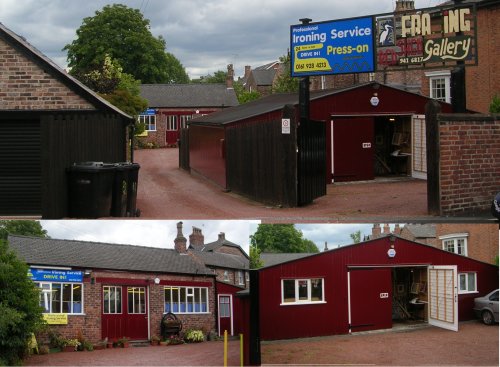
To support these larger enterprises there would be a large number of smaller works dotted around, foundries and forges, small engineering works and electrical equipment repair and manufacture. To support all of these would be wood yards, builders merchants and warehousing. The former builders yard shown below has retained its original buildings although it is now home to two other businesses.
Fig ___ Former builders yard
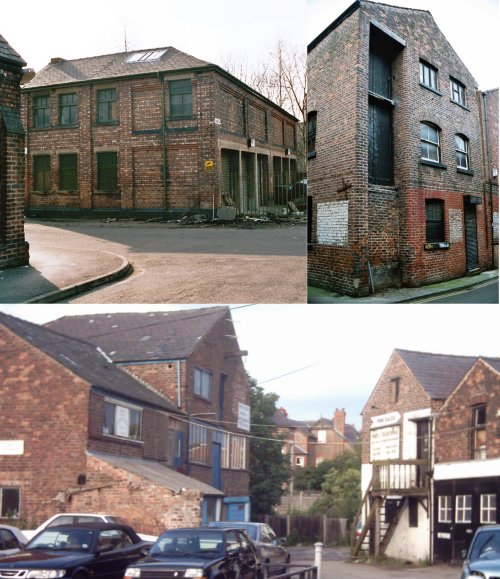
Many of the smaller establishments remained in the town centres, close to the large railway goods yards, smaller factories in town centres were commonplace into the early 1980s. The examples shown below were all still operating and factories into the early 21st century, they are all located on side or back streets in built up areas.
Fig ___ Small industrial premises
Houses followed the factories of course, causing the cities to spread, often following the line of the railways. Efficient rail and road public transport systems were in place by the 1920s and by the late 1930s there was a move toward building properly planned 'industrial estates' outside the towns, all laced with the all important railway lines. The highly passenger efficient railway networks also saw more people moving out of the cities to new housing estates and even purpose built 'new towns'.
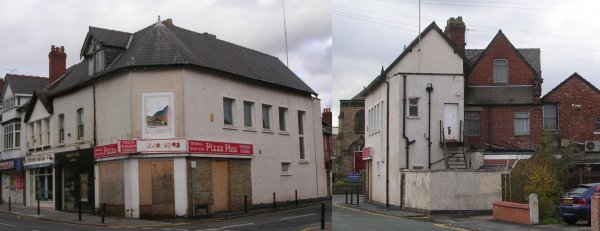
In the industrial centres there was a lot of terraced housing built to provide homes for the workers, most of whom walked to work. A lot of this building was to simple standard designs, producing the Coronation Streets of the major towns. The terraced houses paper kits from Prototype Models or more recently Metcalf models can serve well for these regimented dwellings, but bear in mind that there was a lot of ad-hoc building done. A farmer might sell a parcel of land for a row of houses to be built, often in the form of a small terrace. Later another parcel would be sold and another block of homes built and so on until an entire road was lined with homes, often each block being slightly different from the ones either side. This made house numbering difficult and the terraces were often given names, this is discussed in Appendix One under 'Road Markings & Street Furniture'. As cars were rare (until the 1960s) and most people walked or took public transport, as the suburbs developed short 'parades' of shops were built, and small individual shops were set up on the prime corner sites at the end of roads. Pubs also favoured corner sites and firms such as builders merchants would set up, requiring a yard with several small buildings. In the towns individual buildings had to be erected on the land available, often resulting in some unusual structures (typically tall and narrow buildings). The resulting differences in height, width and detail makes for a more scenic backdrop to the railway and the reader is recommended to look out for old books such as Mr. Ahern's well known 'miniature building construction' (described in the bibliography) which contains pictures of this sort of architecture. Along the railways most houses were built with their rear to the line, this is no bad thing for the modeller as the rear of rows of shops and houses was more varied and (from the modellers perspective) rather more interesting than the front.
Fig ___ Front and rear views of a row of shops
From the 1850s up to the later 1920s Britain really was 'the workshop of the world' however developments in other countries (notably Germany and later the USA) saw the importance of British industry being challenged. The nature of British financial institutions, most set up in the pre industrial age, brought a reluctance to invest in projects that would take longer than three years to provide a return, and this began to take a toll on British industry. By the 1920s although Britain was producing more steel than Germany much of this was of low grade and the actual value of German production was greater. Focusing on low-investment industries left Britain vulnerable to emerging economies such as Japan, Korea, India and China. By the early 21st century Britain was no longer an industrial power, relying instead on banking, tourism and pseudo-industries such as 'call centres' (which rely on technology developed in other countries). However foreign investors, operating under rather different financial structures, have invested in longer term projects in the country with some success, for example the Japanese owned car factories built in the North East are amongst the most productive in Europe.
Industrial Sidings
Some things were common to all industrial or private railway sidings; they must by law be gated where they join the main railway's property and private locomotives would not have travelled onto the railway proper. The most common rail connection was for just a siding or two running alongside the main line into the factory premises. This is handy as the 'factory' itself can form part of the back-scene and need not use up valuable space on the layout.
Lines feeding into areas where road vehicles were operating, notably dock complexes, were usually laid with inset track, providing a smooth surface for the road vehicles. A lot of industrial sidings were laid using conventional track, albeit ballasted with ash and cinders rather than stone ballast, as this was cheaper and made maintenance much easier. Industrial sidings often featured both uneven track and tight curves as speeds were slow.
The railways had by law to be fenced off so where the siding left the railway line it passed through a gate. Similarly factories are fenced off for good reasons, preventing theft for example, so even when located some distance from the railway main line the entrance for the siding would normally have a gate. If the perimeter fence of the industry being served was beside the railway line the gate was often left open but if the line cross open land there would at least be a gate at the railway end and another at the entrance to the factory or yard. If the land traversed were say farm land the siding would be fenced along its length, however inside industrial areas or docks the lines were not fenced. Where the siding crossed a road between the railway and the industry gates were occasionally provided (the junction with the railway was always gated of course). Where the line crossed a road as it meandered through a town (not uncommon on sidings feeding a harbour quay) a man with a red flag would stop the road traffic when the train was crossing. This man travelled on the locomotive, often standing on the foot-step at the front and hanging on to the hand rail on the side of the boiler or engine housing. Although the lines inside the industrial estates and dock complexes were not fenced off this was not as much of a problem as you might imagine as shunting was restricted to specific times and traffic flows were usually regular.
Where privately owned railway lines crossed open areas with property belonging to others to either side they would be fenced off as for normal railways. One example of this kind of line might be the internal railway system connecting a number of coal pits or lines from chalk or limestone quarries feeding a cement works.
When modelling an industry it does help to know something about the type of buildings required and to have some idea of the materials and processes involved and the colours of anything which might litter, dust or splash onto wagons and equipment. Specific industries are therefore covered in separate sections.
Exchange Sidings
Industries that are by their nature dispersed, such as the mines in a coal field, often had tracks which meandered some distance across open country. These linked the various parts of the industry together, connection to the national rail network being at a set of 'exchange sidings' on the main railway line. The exchange sidings were arranged so that the railway company locos could deposit wagons from rest of the system and collect loaded wagons. The works engines would then shunt the stock between the works and the exchange sidings without having to move onto the railway proper. This is convenient for modelling purposes as the works itself might consist of a backdrop, or even be `off stage' forming part of a hidden fiddle yard.
Fig ___ Exchange sidings
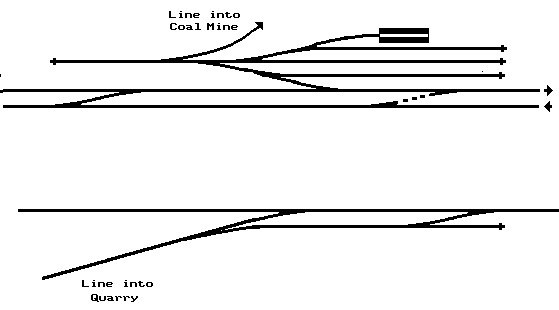
Exchange sidings offer plenty of scope for restrained clutter; a small hut for filling in waybills, another for tools and odds and ends, a few gas lamps and perhaps a short raised platform used for transferring heavy items from railway stock to internal use wagons are all possible additions. The works side of the sidings might contain clues as to the nature of the works itself, for example a couple of rusty five foot lengths of six foot diameter tube lying on the ground at a pipe works.
Fiddle Sidings & Loops
One problem with modelling industries such as coal mines on a layout is that we would not normally see rakes of empty wagons leaving or rakes of loaded wagons arriving. This applies to several industries such as steel works and brick works but is less of a problem where the goods were conveyed in vans or routinely covered, such as flour mills, jam factories etc.
The American Clinchfield exhibition layout features a coal mine and a power station with trains of coal passing from the mine to the power station and trains of empty wagons making the reverse journey. This is accomplished by having a pair of hidden spiral tracks inside a mountain connecting the coal mine on one side with the power station on the other. Loaded trains leave the mine, traverse the layout and enter the power station where they descend the spiral ready to emerge once more 'freshly loaded' at the mine. A similar train of empty wagons meanwhile makes the reverse journey and with careful timing the illusion of loaded coal trains going one way and returning empties going the other was effective.
On a British outline layout, if it can be arranged for tracks to disappear behind the back-scene, we can feed them through to a fiddle/exchange yard at the rear. This allows rakes of empty wagons to go under the loading arrangement and full wagons to be pulled back out. In a domestic layout adding a single hidden track behind the back scene right round the layout and connected to a fiddle yard would allow stock to work realistically from a number of industrial premises.
^
Go to top of page
International Good Guys ~ Making the world a
better place since 1971 ~ Site maintained by

All material Copyright © Mike
Smith 2003 unless otherwise credited