Industrial and agricultural
vehicles and equipment
Note - For more information on cranes and lifting equipment see also 'Wagon Loads and Materials Handling - Materials Handling' which has sections on cranes, lifting aids and 'unit loads'. Railway operated fork lift trucks and straddle carriers are covered in 'Railway Company Goods Facilities - Container handling' For more information on trucks and lorries see also 'Appendix One - Roads and road traffic - Road Vehicles - Commercial Vehicles' for railway operated road vehicles see 'Railway Company Goods Facilities - Railway Owned Road Vehicles'. Barrels, sacks, cases, crates and other packaging that represent much of the 'clutter' in an industrial scene are discussed in 'Appendix One - Packaging Materials & Containers'.
This section discusses the sort of vehicles and equipment that can be used to detail to an industrial or agricultural scene on a layout.
Barrows, Trolleys and Trucks
The barrow remained the primary method of moving smaller quantities of bulk materials right into the 1960s, to get the barrow load into a raised hopper or similar you could either set up a wooden plank to push the barrow up, or you could use a simple chain sling and a hand crane to lift it. The sling has rings to pass over the handles and a hook that engages at the front. Using the wheel as shown is not ideal, but the illustration is based on a professional publication and the hook is definitely in the wheel.
Fig ___ Lifting a barrow

Industry had a range of specialised barrows, the examples shown below are (left) a barrow for powder or granular material and (right) a barrow for liquids and slurries. This kind of thing you would need to make yourself, although with a little thought this is perfectly possible and they do add a distinctly 'industrial' air to a scene.
Fig ___ Industrial barrows

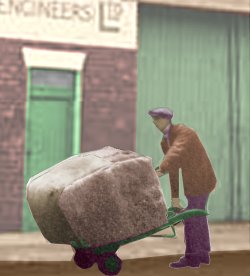
A lot of work was done by hand up to the 1970s, and a simple piece of kit such as a 'sack truck' could be pressed into service for some surprisingly bulky loads. The example shown is a bag of rags being shifted in an engineering works.
Fig ___ The simple sack truck

There is considerable overlap between industry and agriculture in the use of small utility vehicles, a small run-about truck serves well on a dockside, in a factory and at a market garden whilst a tractor can haul loads both in a works or on a farm.
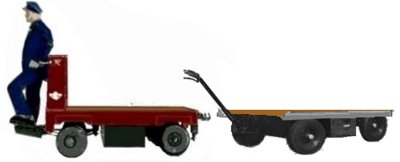
One common bit piece of equipment, introduced shortly before the First World War, was the electric trolley or truck. These came in a range of sizes, some had a driving platform (with a 'dead man's' foot pedal that had to be pressed), others had a steering handle and the operator walked along in front (or behind) the thing. The example in the lower right has a special low-floor, used where heavy things such as milk churns needed to be man-handled on or off the rear bed.
Fig ___ Electric trucks

These little trucks are easy enough to model, the example below is a ;tug' type that was in use on several railway stations for towing luggage trolleys in the 1920s. The chassis is about six feet long and the tow hook is mounted on a spring, probably to protect the machine more than to avoid jerks on the trolley. The design is essentially dead simple, plastic card and strip for the chassis and Plastuct square tube for the boxes with wheels cut from a length of 2mm diameter rod (for N), the only problem might be replicating the chain drive should you wish to go that far.
Fig ___ 1920s electric 'tug' showing main components

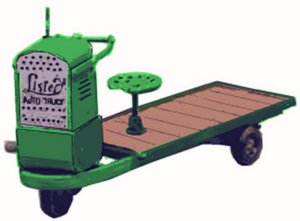
Some very small three-wheeler motorised machines were built for factories and farms, notably by Lister (who also built four-wheeled versions for use on narrow gauge railways). The example below is from the Lister 'Auto Truck' range from the 1930s, the engine powers the front wheel, the entire engine and wheel assembly being pivoted so the thing could turn in its own length. They were widely used in industry and on the docks (notably at fish docks where they transported the heavy fish boxes to the waiting railway vans).
Fig ___ Lister 'Auto Truck'

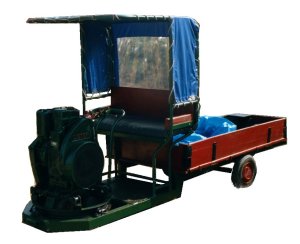
These remained in widespread use into the 1960s, the rather more up-market example in the photo below was used by a market garden type farm near Oxford. It was photographed at a steam plough contest in 2002.
Fig ___ Lister 'Auto Truck' with canopy frame

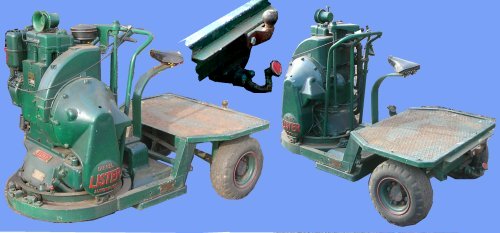
One rather less common variant was the diesel engined autotruck, the example shown below was built as a 'tug', it has a curiously shaped hook at the rear (and has since had a standard ball hook added). Unfortunately this example has lost the original punched metal 'bucket' seat and has a bicycle saddle instead, this one was photographed at the Astle Park show in 2007.
Fig ___ Lister diesel 'Auto Truck' tug

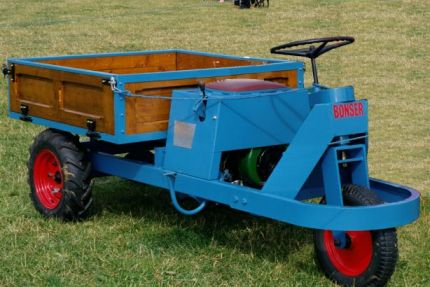
These small machines had exceptionally tight turning circles common on three-wheeled machines, but these small types were confined to internal use in factories and did not venture out onto the roads. The example below, dating from about 1950, was photographed at a steam and classic motor show in about 2002 and has rear wheel drive.
Fig ___ A Bonser three wheel truck from about1950
The small wheels on these machines can be represented in British N Gauge with slices cut from a 1mm diameter plastic rod (2mm in OO gauge).
Tractors
Industry often has to move large and heavy materials about the place, one option is to put it on a trailer and tow it with a tractor. Often surprisingly vintage equipment would be retained on the farm or at a factory, for example steam lorries were penalised from the early 1930s by road taxes based on axle weights, however they remained in use in larger factories such as steel works, dockyards, engineering works and the like where this tax did not apply.
Small four wheeled trailers could be pulled by hand or towed by the little Lister three wheelers described below but for bigger jobs the first option was horses, later supplemented (but never completely replaced) by steam traction engines (which could also be fitted with a crane). Steam lorries were also used within the works, carrying things or towing trailers, my local gas works used a steam lorry to top tanks of ammoniacal liquor about the works well into the 1950s (although by this time it was not used on the roads because of the high tax on steam road vehicles). See also Appendix one - Road Traffic - Steam, Motor and Electric Commercial Vehicles.
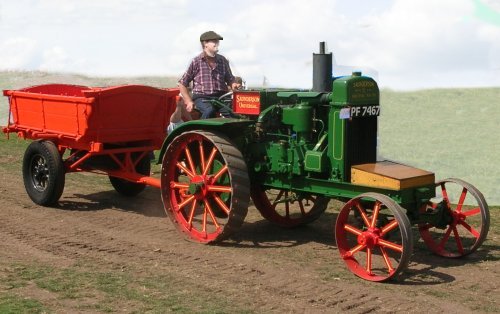
By the 1920s industry was making regular use of oil or petrol powered agricultural tractors, Saunderson (established in the 1890s with a factory in Bedford) was the biggest British manufacturer.
Fig ___ A Saunderson Universal Tractor tractor from about 1914
The slump in agriculture after World War One saw many British tractor firms disappear, Saunderson was bought out by the Crossley Bros in 1924, but they kept it going as Crossley's although this was in competition with Crossley Motors. The business was sold off in the 1930s and became Bedford Plough and Engineering (not I believe making tractors), the Bedford plant closed in the 1970s.
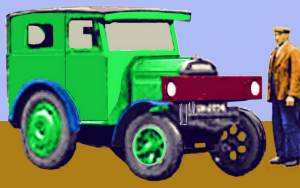
Agricultural tractors were used in larger factories unaltered other than having road-going tyres (sometimes solid rubber, sometimes pneumatic). Some however were more extensively modified for use as tugs. The example shown below dates from the 1930s, it has road-going pneumatic tyres and has a cab fitted, the sketch is based on a photo of such a machine towing a heavy trailer in the 1930s.
Fig ___ A 1930s industrial tractor
The Co-Op in London used an agricultural tractor (fitted with a cab) in the 1930s to tow the road-rail milk tank wagons from the railway yard to their dairy. The LNER (and presumably other railway companies) operated similar tractors, one job being to tow the road-rail tank trailers used for milk traffic from the station to the factory.
The standard tractor could be rebuilt with smaller wheels to produce a tug to pull loads around a works. The example shown below was in use in the 1950s. This particular example was photographed in a copper smelting works, where it was used to pull low trolleys stacked with blocks of banded copper ingots.
Fig ___ Three wheel industrial tractor about 1950
In the post war era one popular tractor was the small grey Ferguson, built for Ferguson by Standard Motors in Coventry. These had a hydraulically powered frame at the rear, called a three point linkage, and a rotating power take off point mounted under that. Ferguson provided a big range of equipment including ploughs, grass cutting shears, and powered muck spreaders. The Ferguson system meant that one man could both drive the tractor and operate the equipment and it revolutionised farming practice.
Fig ___ A post war Ferguson T series tractor with its three-point linkage
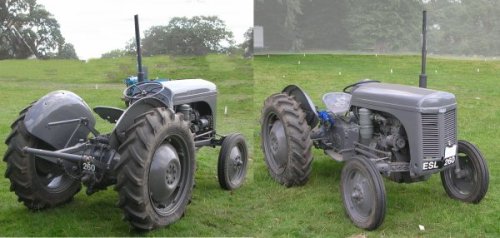
Naturally industry found occasional uses for this machine as well, although the primary function of industrial tractors remained the towing of heavy bits of kit about the place. Up to the 1930s a lot of farm tractors had metal plates on the driving wheels, intended to provide better grip, in industrial use these were removed and solid rubber tyres were fitted. Solid rubber tyres remained in use on industrial tractors into the 1950s although by then farmers were nearly all using inflatable tyres (other than on very old machines which lacked the appropriate wheel rims). As industrial tractors were often used on an occasional basis there were often older designs seen in factory yards some years after they had been replaced on the farms. The Fergusen T20 of 1952 was released in a purpose built 'industrial' version, complete with mudguards over the front wheels and larger then usual mudguards on the rear wheels. Note that the front mudguards were removable, they had to be taken off if the 'front loader' bucket attachment was used (illustrated later in this section).
Fig ___ A 1952 Ferguson T20 Industrial tractor from an advert of the time
Industrial tractors were often fitted with mudguards, and did not have the heavily ribbed rear typres seen on agricultural types. The example shown below was intended for use towing aircraft about at airfields.
Fig ___ A 1950s David Brown industrial tractor
Langley offer both modern and period (1940's-1960's) tractors and use these to offer a ground preparation scene and a harvesting scene with additional models of farm equipment.
For more on tractors see also Lineside Industries - Vehicles & Related Equipment - Traction Engines and Tractor Manufacturers
Fork Lift Trucks
The modern 'fork lift truck' evolved from chain-and-winch hoists of the late 1800s and the small run-about petrol trucks from the early 1900s. In 1917, an American company built a lift truck for use in its axle factory, and visitors soon were requesting the company to build such machines for them. The “Tructractor” shown below was the first machine from the Clark Material Handling Company who went on to become one of the major American fork lift manufacturers.
Fig ___ 1917 'lift truck'

Containers pre-date the railways (they were used on the early canals), and with the industrialisation of the textile industry 'portable platforms' were developed that could be craned on and of road or railway wagons. These all used standard cranes and were not designed for warehouse handling so much as transportation. During World War One there was a manpower shortage and Ransomes, Sims and Jeffries of Ipswich developed a small range of material handling equipment which sold well. These small trucks, generally fitted up as small cranes, were common in industry by the 1930s.
In the USA several firms were experimenting with the fork lift and pallet idea in the later 1920s but the true fork lift, and the pallet as we know it today, were really developed during World War Two (mainly by the US military who had to fight the war over considerable distances). The example shown below left dates (I believe) from about 1940, the driver stood on the plate at the back end of the machine. The example on the right is an early British machine from 1946, the driver has a seat (a punched metal agricultural tractor seat) but it is still cable, or in this case screw-drive, operated.
Fig ___ 1930s and 40s fork lift trucks

Initially the British were slow to take up the pallet, but by the later 1950s pallets, and fork lift trucks, were common in larger factories. By this time they were getting quite sophisticated, the illustration below shows a rather beefy Italian fork lift from the later 1950s, equipped with a telescopic mast.
Fig ___ 1950s large fork lift truck

By the 1960s the common counterbalance fork lift design was fairly standardised and they were built in a range of sizes including some quite large machines for heavier industrial uses. Tractor companies produced anything they thought they could sell, the example below is a David Brown fork lift from the later 1970s, based on their standard tractor and able to operate on rough ground. The driving position is reversed, so the machine is now rear-wheel steering, a common feature on fork lift trucks.
David Brown fork lift

By the 1970s fork lifts were increasingly fitted with a cab to protect the driver if the load fell back over the mast. The example shown below is a rather heavy fork lift at work in a brick works in the 1970s (for examples of very large fork lifts see also 'Lineside Industries - Waste disposal').
Fig ___ 1970s fork lift in a brick and tile works
By the later 1980s the supermarkets dominated the retail trade and they used massive 'distribution centres' which in turn lead to the development of ever more sophisticated fork lift trucks. Some have telescopic masts that can reach fifty feet or more, then turn and move the pallet sideways onto racking. These types are however generally only used inside.
Other than for warehousing there has been something of a convergence between cranes and fork lift trucks. A British firm (possibly R. H. Neal) developed the now ubiquitous 'telehandler' with a rear hinged telescopic rectangular mast and jib (I think this was in the 1970s, rectangular hydraulic crane booms came in the the 1960s) however the fork-lift attachment is only one of several pieces of kit that can be fitted to these new machines (technically the machines with these telescopic jibs are caled 'variable reach fork lifts').
Fig ___ 'Telehandler' with fork lift attachment
Modern telehandlers can reach as high as 75 feet (23m) and some can carry loads of up to 25 tons, ligher machines now have full 360 degree slewing as well. When fitted with a winch (so they can operate as a light crane) they are required to have a full set of crane safety gear fitted, at least in the UK.
'Conventional' fork lift trucks, sometimes fitted with specialised lifting gear for rolls of paper or oil drums, remain common in factories but the larger hybrid crane/forklift machines are often seen in locations such as building sites, quarries and heavy engineering factories.
After the introduction of the container it was not long before very large fork lift trucks appeared to move them, see Lineside Industries - Waste Disposal' for examples used at a corporation rubbish processing centre. By the mid 1980s these very large machines were capable of stacking containers several levels high and were also used for lifting road trailers onto modern railway transporter wagons (see also 'Railway Company Goods Facilities - Container handling'). One option for these giant machines is to use a model intended for a larger scale and replace the cab (I made one for a friend using a cheap whitemetal 'fork lift truck' toy in this way).
Fig___ Fork Lift and Reach Stackers used for swap-bodies and semi-trailers
Factory and farm mobile cranes and platforms
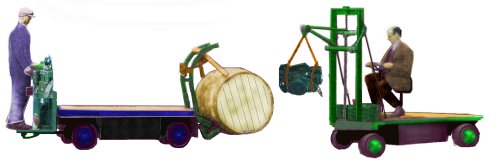
The small electric trucks could be fitted with a range of attachments to handle specific jobs, in the days before the 'fork lift truck' (that is pre world war two) a crane attachment was a common option. These came in all shapes and sizes, some built by specialist firms, other thrown together at the factory where the machine was being used. The examples below are sketched from photos taken in the 1920s. The example on the right is a purpose built machine, it uses a screw-drive to move the lifting frame up and down the support arms.
Fig ___ Electric trucks with crane attachments
Cranes featured in many industries, where the works were large a mobile crane on a steam traction engine might be used, these were seen in foundries or forges where heavy items needed moving about the site.
Fig ___ Traction engine with crane attachment

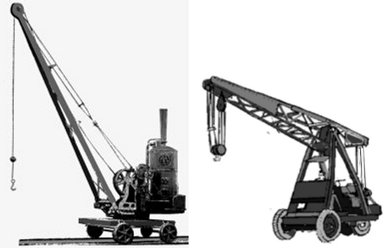
In smaller works, stone yards, wood yards and the like a small steam crane on rails was more common. In the 1930s small petrol engine cranes appeared in some numbers, and in a range of sizes (the example shown below is quite a large variant). These generally replaced the steam cranes in more prosperous works, but in wood yards and the like the old steam cranes soldiered on into the 1960s or even 1970s. The example shown below right is a small petrol crane at work in about 1950.
Fig ___ Small steam crane on rails and 1930s and 1940s petrol cranes


Up to the 1960s cranes used cables (sometimes chain) to lift and lower the jib and load, one popular machine born in the 1930s which served well into the 1970s was the Chaseside crane, a modified tractor fitted with a fixed jib.
Fig ___ Chaseside 2 ton petrol crane

Hand powered equipment was common into the 1960s, the small mobile crane shown below is the Pilot Universal Jack and Crane, sold by Messirs Gibbins & Co of Birmingham in the later 1930s, it could lift 30 hundredweight to a height of 7 feet.
Fig ___ Small hand powered crane

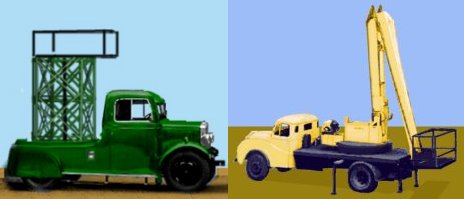
During World War Two a lot of progress was made on the development of hydraulic systems, including the all important seals used on rams. This allowed the development of a range of machines using hydraulics, replacing the complex combinations of pulleys and wires. The examples below are lifting platforms used to access high things such as street lamps, the motor truck on the left is a cable-operated 1930s vehicle, the hydraulic machine on the right was sketched from a photo taken in the mid 1960s.
Fig ___ Platform trucks
In the 1960s cranes with rectangular telescopic jibs appeared, and these soon became the norm, although the load was still lifted using cables and a winch.
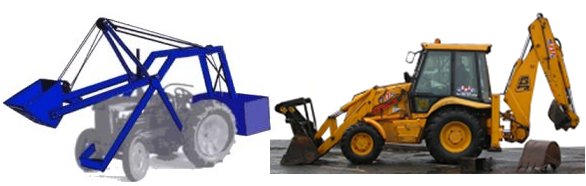
The 'JCB' with the hydraulic ram operated bucket on the front and 'back hoe' on the rear is a distinctly post-war development, machines of that type had to wait until the problems of hydraulic rams were solved. The JCB first tractor with front loading bucket and rear mounted hydraulically operated back-hoe appeared in 1953. Most cranes and diggers used wire ropes, the example shown below left is a Chaseside loader attachment on a tractor (first introduced in the kid 1930s these remained in common use into the 1960s, a few probably survived into the early 1970s). Once the seals on hydraulic rams had been perfected they soon appeared on most equipment including the 'front loader' buckets. The example below right is an early 1950s Ferguson T20 'industrial' tractor with its optional front loader attached.
Fig ___ The 1937 Chaseside loader and 1952 Ferguson with front loader

One bit of kit that found favour with coal merchants in the 1950s was the 'Pelican Loader', a hydraulic grab mounted on a jib fitted to the chassis of a Fordson tractor and designed specifically for unloading bulk minerals from railway wagons. These were developed in New Zealand, and built under licence in the UK by R.H.Neal & Co Ltd of Ealing. Photographs are rare but Tim Whyte sent in a scan from an advert on which the sketch below is based. The driving position was reversed, so the machine was rear-wheel steering, and the supporting frame was mounted directly onto the 'rear' (now front) axle.
Fig ___ Pelican loader

In 1953 the JCB appeared, fitted with a front loader and also a 'back hoe' on the rear. By this time there was usually a cab on both agricultural and industrial tractors although the agricultural type tended to have an open back so the driver could still reach back to operate some of the older machinery used on farms. The front bucket on the JCB can be of various sizes, fitted with chains it can be a handy little crane for moving heavy kit about. The rear mounted backhoe can also be fitted with a range of buckets and is very useful for digging trenches. The backhoe can also carry a hydraulic drill, a steel spike repeatedly hammered by a hydraulic drive and used to break up road surfaces in place of the man with pneumatic drill (but just as loud). The JCB shown below left is typical. By the 1970s tractors were less widely used for towing things around the factories but they remained common in some applications, the machine below right is a typical agricultural/industrial machine, seen in yards handling bulk minerals of all kinds.
Fig ___ JCB type front loader

As well as converted tractors there were increasing numbers of purpose built wheeled and tracked machines being deployed, this sort of machine has been widely used loading both lorries and railway wagons since the late 1960s. By the 1970s they were often larger machines than the (essentially agricultural) multi-purpose tractors, the example below is a Caterpillar 950 'wheel loader'. The large bucket would be used for materials such as sand and gravel.
Fig ___ Typical bucket front loader - 1960s to date
Excavation Equipment
To dig big holes in the ground you need a big digger, technically these are cyclical machines as they repeat a simple set of actions. The first patent for such a machine went to a William Otis in America in 1839. The first machines consisted of a steam boiler mounted on one end of a platform with a swinging boom mounted at the other end, the platform ran of rails and temporary tracks were laid as required to position the beast. Machines of this type were still being built into the 1890s and some remained in use into the 1920s. In the early 1880s the British developed the type with a revolving cab and jib, known as a 'full swing' revolving shovel, and this soon became the norm for these machines. Up to the later 19th century they used chains to operate the bucket arms but from the 1870s wire ropes were increasingly used.
The early rail mounted excavators were valuable in digging cuttings and the like but could not work effectively when digging below ground level, the main alternative to men with shovels was the bucket chain excavator, essentially a series of buckets connected by chains forming a loop around a long arm which could be lowered into the ground.
Machines of this general type were the mainstay of large scale excavation work from the later 19th century, the early 'steam navies' revolutionised projects involving major earth works such as the Manchester ship canal. Their main applications were in major construction projects, road building and quarry or open cast mining. The bucket chain machines were also used for digging trenches, diesel engined machines using this method of excavation were built well into the post world war two era but they were never common as they were awkward to use and a 'back hoe' (discussed below) could dig trenches and also perform other work.
The rail mounted machines were built to run on a range of gauges, large machines often had a pair of narrow gauge tracks to support their weight and make them more stable. They dumped the spoil into tipping railway wagons on a second track run beside them.
The original work on caterpillar tracks for vehicles was done by the Yorkshire inventor Sir George Cayley in the nineteenth century. In 1904 the chief designer at Richard Hornsby & Sons took out a patent on 'chain tracks' and in 1905 Horsby fitted tracks to a steam traction engine (built in 1896). They also tried it on several Hornsby oil powered tractors, but despite energetic promotion, including the first film ever made for commercial purposes (1908), the idea did not catch on. The original steam powered machine was sold in 1910 to the Northern Light Power & Coal Company for hauling coal and supplies in a train of road trailers to the Klondike gold fields in the Yukon 'gold rush' (I understand that this steam tractor has since been found and is to be restored in Canada).
Fig___ Early tracked traction engine
Hornsby then lost interest and sold the patent rights to the American firm of Benjamin Holt in 1914, this firm went on to produce a steam powered tricycle-type crawler (with rear drive tracks and a forward steering wheel) which was moderately successful in American agriculture and during World War One British and American steam crawler tractors were used by the allies to haul heavy artillery about the place. The tracked vehicle received a boost with the development of the tank in World War One, it had excellent cross country performance and did not require rail lines to be laid. By the 1920s the rail mounted excavation machines were rare, by 1930 they had virtually disappeared, mainly replaced by machines on a tracked 'crawler' base.
The name 'caterpillar' was coined by a photographer taking photos of one of Holt's track-laying tractors. Mr. Holt liked the comparison and adopted it as the name for his track-laying system. In 1925 the Holt company merged with the C. L. Best Gas Tractor Co. and the new enterprise was renamed the Caterpillar Tractor Company.
Menck & Hambrock, a Hamburg-based German steam and diesel shovel builder, were the first company to produce crawler mounted shovels in 1923.
Electrically powered rail-mounted and caterpillar tracked machines (fed by a trailing cable) were in use by 1908 and although they were never common in British (other than for dock or factory cranes) use they found favour in the USA. By the 1930s the 'oil engine' was the most common power source used on British equipment, these could be diesel or petrol, or for light duties paraffin fueled. Although less reliable they had several advantages for intermittent work and by the mid 1930s very few steam powered excavators were being built. A steam powered machine is however inherently robust and easy to maintain, so steam cranes remained in regular use into the 1960s (later in the case of small cranes used in some industries such as wood yards). Up to the 1960s these machines were predominantly cable-operated, which restricted their range of options.
Probably the most common big digger was the 'face shovel' or 'dipping stick' developed from the original steam shovels. These could be used to dig away at something standing in front of it, but was little use digging away at the ground. The main supporting arm sticking out of the front of the crane body is called the boom, the arm with the bucket on it is called the stick.
The example below is a typical cable operated face shovel or 'dipping stick bucket', the main jib can raise and lower and the bucket is on rigid arms run through a 'rack and pinion' (toothed wheel) arrangement so it can move up and down with regard to the jib as well as swing through an arc. This machine can dig down in front of the crane, but not very deeply or very far out and not steeply.
Fig___ Typical 1930s diesel excavator
By reversing the bucket on a face shovel the machine could dig down towards itself, making it a 'hoe' or 'backhoe', this action allows it to be used for digging out holes for the cellars of buildings and for digging trenches. These machines were used from the 1860s but it was the 1920s before they appeared in any numbers. They were usually purpose built and generally had the arm carrying the bucket mounted on the end of the boom and not fitted with a rack and pinion. On the early machines the bucket was mounted onto the end of the dipper stick near the front of the bucket but had a rigid brace running from the dipper stick to the rear of the bucket itself. The 'wrist action'. using a pivot on the end of the dipper stick giving the ability to curl the bucket back against to dipper stick, seems only to have come in with hydraulic machines (I could be wrong on that). The cable operated hoe was I believe less common than the forward acting types and another rather rare beast was the 'scraper', I have only ever seen a single photo of this type of machine. This had a boom on the underside of which a wheeled carriage carried the bucket (the bucket being similar to that on a face shovel with a rear door). This was lowered to the horizontal and the bucket was drawn toward the outer end of the boom to produce a level surface. The sketches are based on a model I made many years ago using a Peco van kit for the cab, the model ended up as a face shovel. The chassis is built up from layers of 30 thou card, the wheels were cut from tube and filled with Milliput (pressed with a finger whilst wet to give a dished-in outer face) and the tracks were paper, parallel lines were drawn for the individual plates using a ball-point black pen (pressing hard to produce indented lines). The paper was then tinted dark grey with water colour and strips cut and glued on with Evostick. The big pulley on the end of the jib was the smallest press stud I could fins (I had trouble gluing on the cable to the outer rim of this). I used lengths cut from small bolts to represent the small pulley wheels, the groove in which allows fishing line cables to be glued in place. The winding drums inside the body were also cut down lengths of slightly larger bolts.
Fig___ Back hoe and scraper or skimmer
The scraper or skimmer was generally replaced in the later 1930s by the towed scraper trailer (sometimes called an onion skin scraper) which had a bucket in a frame, lowered at the front to trim off the surface (horse drawn versions had been in use since the 1880s but these lacked the power to pull through rough and rocky ground). These are discussed and illustrated below.
In about 1900 a chap in America developed the 'drag crane', which lowers a bucket and drags this along the ground to scoop out material. The jib on a drag crane could be much longer, giving a greater reach into flooded areas and allowing the crane itself to work from firm ground. The drag line was also well suited to digging down below the level of the crane, these soon found wide application, notably in sand and gravel quarries. They rely on the weight of the bucket and so are less powerful than the dipping bucket or back hoe machines, on which the rigid arm helps force the bucket through the material being dug.
Fig ___ Steam and diesel excavators and a drag crane
The suggested jib for the drag crane is either one or two OO scale lattice signal masts (such as those from the Ratio LNER signals kit), if using two glue their glued together to form a single long jib. The bucket is made as for the scraper but the rear panel is not a door so fill the end with Milliput and sand to shape. The chassis could be made as for the scraper and back hoe described above.
The bucket on a drag line is not difficult to make, it has a bottom and three sides with a curved bar across the top of the open end. The bucket is carried on chains secured at the rear end, similar chains (C) are connected to the front and a heavy cable (A) pulls the bucket toward the crane. A separate cable (B) attached to the pull-block passes back over a pulley (D) and back down to the front of the bucket. Providing the tension is kept on cable A the bucket remains horizontal, when this is released the bucket tips down to empty. Dave Rowe famously built a working drag crane for his superb OO scale Leighton Buzzard sand quarry layout (see also bibliography), but the 'works' extended down about five times as far as the crane was tall.
Fig ___ Drag line buckets
An alternative was the 'grab' type bucket, although these were generally of smaller capacity than the drag crane bucket and as they used a straight lift from the end of the jib they could not reach out quite as far. The earliest references I have found to these devices were from about 1900, there were various designs, the most common are shown below, the standard clamshell type (shown on the crane) and the 'scissors' type (right centre) both remain in use today The hydraulic type (top right) is a post world war two development. Making a small working grab for N Gauge is not really practical as it is difficult to get enough weight into the grab to make it work.
Fig ___ Grab buckets
The development of hydraulic rams during World War Two had a profound effect on the design of excavation machinery. By the later 1960s the cable operated machines were increasingly being replaced by hydraulically operated equipment. The face shovel or 'dipping stick bucket' was largely replaced by large wheeled 'front loaders' (described above) or by tracked version (called 'multi terrain loaders') by the 1980s although occasional older machines did remain in use. The drag-line excavator and clamshell grab remain useful for specific jobs but the principal excavator from the 1970s onwards was the hydraulic back hoe with its 'wrist action' bucket.
Fig ___ Hydraulic back-hoe excavator
Having dug a hole, then filled it, you often need to level the top down and there are two types of machine used for this. First came the 'grader', an angled blade originally made of wood and pulled by horses (some were fitted with shafts to allow the horse to push). This evolved into a wheeled machine on which the height of the blade could be adjusted. This moves the material about but a later development was the 'scraper' which is essentially a drag line bucket mounted on wheels, the front end of which is lowered down to scoop up material from the surface. By the 1920s these were both all-metal machines, usually towed behind a powered tractor of some kind. By the 1930s graders were typically self powered (as shown below right) but towed scrapers were in use well into the 1960s (increasingly being replaced by purpose built self powered machines).
Fig ___ Late 1930s towed scraper and grader
By the later 1920s the machines were often being towed by a tracked vehicle. In 1925 the Holt company (who's owner developed a successful tricycle type crawler tractor in 1914) merged with the C.L.Best Company of California (who made petrol powered crawler tractors) to form the Caterpillar Tractor Company. One of the machines designed by Best's in about 1919 became the successful Caterpillar 60. Note these early Caterpillar machines were originally painted in shades of grey (I think they were yellow by the later 1930s).
Fig ___ 1920s Caterpillar 60 tractor
Bulldozers pre-date even the traction engine, the original device was a wooden blade pulled, or pushed, by horses or bullocks. This was used to spread out material dumped by carts and was initially known as a 'bull grader'. The term buldozer came in the early 1930s and technically applies only to the blade itself, not the whole vehicle. Powered machines fitted with a bulldozer blade probably date from about the time of World War One, I understand that the American Holt company fitted one to their steam powered crawler traction engines at about that time however I believe that the first successful bulldozer was based on the Caterpillar Sixty Horsepower tractor (shown above) in about 1926.
Prior to the 1950s machines were fitted with a bulldozer blade mounted on arms which ran back toward the rear of the chassis, the arms had a pivot at the rear end and the blade was lifted and lowered by cables running from a frame on the front of the machine (as below left). Cable operated machines remained in use into the later 1960s but they rely on the weight of the blade to bite into the cut, from the mid 1950s hydraulic rams were increasingly the norm as these can push the blade down into the cut. On the early machines the rams acted on swinging arms to raise or lower the blade (below right). by the 1970s the rams were mounted upright (diagonally) on either side of the radiator and acted directly on the blade.
Fig ___ 1930s and 50s Caterpillar bulldozers
After the war British industry tried to adapt to peacetime needs, but they had been focused on war production for five years and before that they had been through a serious economic depression. New technologies developed during the war required investment, but it was the countries who had seen their industrial base destroyed who built new plant, the British tried a make do and mend approach
.
The buldozer shown below is the Vickers Vigor, built using tank parts. The hydraulic rams are mounted on the side of the engine casing, the dozer blade being supported on heavy rear-hinged arms. It was both fast and powerful but it suffered from reliability problems and foreign makes soon came to dominate the construction equipment scene.
Fig ___ Vickers Vigor bulldozer
^
Go to top of page