Return to index page

Fertilisers


Fertilisers include about twenty chemicals required for healthy plant growth and fertiliser companies also supplied other materials such as lime for treating acidic soils.

In the mid 1980s when I first compiled this section three quarters of the fertiliser produced was used by about one quarter of the world's population. Holland got through as much as all of South America and India's 500 million used only as much as Sweden's 7.5 million. It was estimated at the time that at the present rate of production the weight of one years fertiliser should exceed the weight of all of humanity by the year 2000.

At the receiving end the fertilizer may be spread on the land during the winter or shortly before seeding time. The manufactured fertilisers can be liquids or solids, usually 'prills' (small round or needle shaped pellets). Prills are made by spraying droplets of molten fertiliser into the top of a tall tower. Prior to the 1960s a lot of fertiliser was supplied as a powder but problems with caking lead to the development of pelletisation, including 'prilling' to allow mechanical aids to be used in spreading the stuff. In the 1970s and 80s ICI used leased 4 wheeled hoppers in their livery to deliver 'prills' of Urea (a nitrogen fertiliser material, rich in nitrogen, made from ammonia and CO2 and mainly used in compound fertilisers but also used for resins and glues).

The modern mechanical aids for applying fertiliser only appeared in the 1950's when tractors with a practical power take-off were introduced, before that the standard method for all types of fertilisers and manures was to haul a cart across the field and spread the stuff with spades and forks.

In the 1960s and 1970s some fertilisers, such as phosphate and basic slag, were spread using a powered trailer, typically with a spinning disk at the rear and a conveyor mechanism to feed the cargo back to the outlet. By the 1980s the IBC or 'big bag' was the preferred delivery method (see also Unit Loads - Pallets and IBCs for more on the 'big bags') and specialised machines were built so that these could be used directly without having to empty the bag into the machine first. Since the later 1970's some commercial fertilizers are supplied in a form that allows them to be placed in the soil, along with seeds, by drills and planters. Manure and other consolidated fertilizers are applied most efficiently by a muck spreader, the early types were a trailer, taking power from the tractor and equipped with a bottom conveyor to carry the fertilizer back to a beater attachment at the rear. This disintegrates the compacted muck and then scatters it on the ground.

Fig ___ International Harvester muck spreader at work in the later 1950s

Photo of working muck spreader from a 1950s advert

In the 1960s a new type of muck spreader appeared, this has a cylindrical body with an open section on one side and a powered revolving rod down the middle. Chains attached to the rod serve to throw the manure out sideways. These are known as 'side discharge' spreaders, the earlier type are now called 'rear discharge' but they are less common these days as they are mechanically more complicated. The later type of side discharge spreader is illustrated in the section on 'Wagon Loads and Materials Handling - Road vehicles and Farm Equipment'


Modelling a Fertiliser Works


There were, and are, a range of fertilisers used in the UK, more detail on these is in the following paragraphs. There were also a great many firms engaged in the production of fertilisers, details on several have been appended to the end of this section, however not all firms made all types of fertiliser. Fertiliser works were generally quite extensive establishments, but for a smaller establishment you could opt for a blender or compounder, buying in the basic fertilisers and mixing these to suit local needs.

The pre World War Two buildings used for fertiliser works had no particular distinguishing features that I could identify although most seem to have had a tall chimney. They followed the architectural styles of their time, those built in the Victorian era or shortly afterwards had ornate facades and expensive materials to the front, with plain stock brick to the rear. Those built in the later 1920s and 1930s tended to have flat roofs and 'streamlined' styling (although curved corners were not common on these rather 'agricultural' structures). In the post-war era large corrugated metal buildings have been set up. Post war fertiliser plants using ammonia sometimes use large spherical tanks and have a tall column (similar to an oil refinery 'fractionating column').

Traffic to a rail connected works would depend on the types of fertiliser being produced, the possibilities include:
Phosphate fertilisers - Sheeted open wagons of guano (getting rare by the time of Word War Two) and bagged material such as fish and animal bones. Open wagons of phosphate rock (the factory usually had it's own stone crusher, generally rather a big one but the illustration of a small machine in 'Lineside Industries - Mines - General introduction' may be of use). Tank wagons of sulphuric acid and/or open wagons (typically three plank) of carboys of sulphuric acid.
Nitrogenus fertilisers - Ammonium sulphate can be made using ammoniacal liquor from a smaller gas works (larger works used it to make fertiliser on-site), delivered in tank wagons. To make the sulphate you would also have tank wagons of sulphuric acid and/or open wagons (typically three plank) of carboys of sulphuric acid. A lot of this was shipped in sacks, often double bagged. It tended to corrode metal fittings especially if it got wet. Ammonium Nitrate is made by reacting ammonia with nitric acid, it is used in both solid and liquid fertilisers, nitric acid could also be supplied in either tanks or carboys. Calcium nitrate is made by neutralizing nitric acid with limestone, sodium Nitrate has been manufactured (since the 1930s) by reacting sodium carbonate with nitric acid. For post world war two you can add spherical tanks for anhydrous ammonia (a gas that has been chilled to a liquid form and pressurised for storage. Rail gas tank wagons would be used to supply the gas.

The plant might blend or compound the above with imported potash, basic slag from steel works, animal and human manure all delivered in open wagons, usually sheeted.

The outgoing goods would be bagged and shipped either in vans or (more likely) sheeted open wagons. As with the merchants mentioned above one aspect of interest was the use of hired-in PO coal wagons, these would be sheeted for the bagged traffic. They were seen delivering fertiliser during the summer months when demand for coal was low and before the autumn demand for fertiliser picked up.

The illustration below contains bits of several fertiliser works and serves to show the characteristic elements of a modern (1960s to date) nitrogenous fertiliser works. 'A' is the distinctive building used to house powders, 'B' is a cooling tower, which is optional, 'C' is the pipework and tanks used in the processing of the product, 'D' (at the rear) is the large building where the process takes place, 'E' is the tower associated with these works, 'F' is a tall chimney, you need at least one of these and 'G' are the spherical tanks mentioned above used for holding ammonia.

Fig ___ Composite illustration showing one type of modern fertiliser works

Composite illustration showing one type of modern fertiliser works

For factories dealing in phosphates or making calcium nitrate you can use 'quarry' type structures, used to hold the raw materials at more modern plants. You will also require tanks for the sulphuric acid used in the process and somewhere to unload the rail-tank deliveries (unless de-mountable tanks are being used). If the plant is making sodium nitrate you also have tanks for nitric acid.

An alternative is a fertiliser distribution depot operated by one of the larger firms, typically a large structure clad in corrugated iron with the name of the firm writ large on the side or end. A larger company might buy the premises of a failed agricultural merchant to serve as their local depot, so something on the lines of the larger brick-built depot shown above would also serve. By the mid 1930s Fisons were using articulated petrol lorries with trailer sides two feet high to deliver supplies of bagged fertiliser from their distribution terminals to their customers. The pictures I have seen of Fisons depots featured a siding using inset track and sharing the same loading bay doors as the lorries. The illustration below is based on a photo, the front of the trailer was curved, the logo one the door is shown on the right. Note the spelling of Fertilizer with a z - this was taken from a photo of an actual Fisons lorry in the UK (I believe).

Fig ___ Fisons delivery lorry in the 1930s

Sketch of Fisons delivery lorry in the 1930s


Common Fertilisers


Early fertilizers were all organic; farmyard manure, composts, bone meal, blood, seaweed meal, and fish meal (in 1914 both the Hull Fish Manure and Oil Co and the Humber Fishing and Fish Manure Co were in business). The railways were involved in shipping natural manure from the 1840's, there was rather a lot of this to shift as horses provided most of the power and human manure, collected by local councils and sold as 'night soil', was also a regular cargo (see also 'Appendix One - Water, Sewage and Rubbish Disposal'). Cheap rail-hauled coal meant that lime could be made much more cheaply and other materials such as wool and cotton waste (called shoddy) was shipped from the Northern mill towns to be ploughed into the land. The farmers also required consignments of chalk, limestone, gypsum, phosphate and 'basic slag' (from steel works).

There were some rather bizarre fertilisers used over the years, Simon Harding e-mailed with a link to point out that we once imported Egyptian mummified cats for processing (http://www.britishmuseum.org/explore/highlights/highlight_objects/aes/m/mummy_of_a_cat.aspx). The following is a quote from the British Museum website:
Unfortunately, many cat cemeteries were plundered before archaeologists could work in them: A shipment of as many as 180,000 mummified cats was brought to Britain at the end of the nineteenth century to be processed into fertiliser.


The three most important fertilisers are nitrogen, phosphorous and potassium and fertilisers are usually described by citing the percentage of each in the mix. The phosphorous and potassium are usually used in the form of phosphoric acid (phosphorous anhydride P2O5) and potash (potassium oxide K2O).

One of the more important fertilisers was 'guano' (compacted bird dropping built up over many hundreds of years, mostly recovered from large deposits found on islands off the Chilean and Peruvian coasts and from Ocean Island in the Indian Ocean). This material is white and powdery and arrived in the country in bulk or in bags (sacks). Guano is mostly lime phosphate and ammonia and so contains all three of the important ingredients (about 10% nitrogen with about 60% phosphorous and 2% potassium).

Not all guano was guano however, in London the Native Guano Company set up in 1888 and originally based in Kingston-upon-Thames they moved to Southall following complaints from their residential neighbors in 1909. This firm took in the sewage from several London sewage farms (at Kingston it was supplied by pipeline, at Southall it arrived in barges) and processed this to separate the water (returned to the Thames) and the useful solid matter, which they dried, pelletised and sold as fertiliser. This was considered a valuable fertiliser and quite a lot was exported. The only drawback is that tomato seeds will pass through the human gut, and the subsequent processing, so sometimes you will find tomatoes growing where you thought you had planted something else.

Ammonia contains Nitrogen and so forms the basis for many of the more important fertilisers. Sewage sludge, fish scraps and manures such as guano are all used as fertiliser in part because of their ammonia content, since the Second World War 'animal tankage' (discussed below) has also been used for this purpose. Ammonium sulphate was made in quantity at the town gas works and at the coke plants associated with steel works by reacting ammonia with sulphuric acid (see also 'Lineside Industries - Gas Works, Coke and Smokeless Fuels' for details of their ammonia production and uses). Ammonium Nitrate is made by reacting ammonia with nitric acid, it is used in both solid and liquid fertilisers, manufacture of this was (I think) confined to the fertiliser plants.

Shortly before the First World War the Germans devised a way of synthesising ammonia directly using nitrogen from the air and hydrogen from coke furnace gas (cooking them together in an oven with a catalyst, under considerable pressure). By the end of the Second World War the UK was going through a million tons of fertiliser made from synthetic ammonia and a further quarter of a million tons based on the ammonium sulphate from gas works and coke plants.

Since the Second World War some farmers (mainly in America) have experimented with injecting ammonia directly into the ground, however as it is a gas at normal temperatures the liquid form is contained under about 211 lbs per square inch, requiring a substantial cylinder to hold it. Also ammonia gas is an irritant (you do not want to find yourself in a gas cloud), so it is injected a few inches below moist soil (where it is absorbed by the water, however it is the cheapest and most concentrated way to supply it to the land.

Other nitrogen based fertilisers include calcium nitrate, made by neutralizing nitric acid with limestone, potassium nitrate ('Nitre' or 'saltpetre') and sodium nitrate or 'Chile saltpetre' which occurs naturally. Both potassium and sodium nitrate are found in naturally occurring deposits in Chile, from where the UK has imported large quantities of the stuff. Sodium Nitrate has been manufactured (since the 1930s) by reacting sodium carbonate with nitric acid.

Phosphorous is mainly supplied in the form of phosphates. Simple phosphate fertilisers are made from pulverised bones (animal and fish bones have both been used) or phosphate rock, a naturally occurring light grey mineral imported from America, Russia and North Africa in the form of rubble. The 'knackers yard' was originally where old horses were sent to be killed and processed, other dead animals often ended up there including cats and dogs and butchers sent the bones left from their trade. The recovered meat was sold off and the bones were then boiled off to remove the fat (which was sold off, some going into margarine). Some of the bones were used to make glue and the rest were powdered to produce 'bone meal', a white powder sold as fertiliser in bags.

Artificial fertiliser (as opposed to manure) actually dates from the manufacture of superphosphates in 1842 by a Mr John Bennet Lawes (who set up the Rothamsted Experimental Station at Harpenden in Hertfordshire, one of the oldest agricultural research establishments in the world and still going). He found he could treat a mineral called coprolite (actually fossilised dung) with sulphuric acid to produce a solid form of phosphoric acid (see under Chemicals, salt and plastics industries). The alternative base material (calcium phosphate) was from animal bones or imported guano and later pulverised phosphate rock. Superphosphate was a crystalline material and was often shipped in jute bags although the fumes tended to rot through the bags if stored for any length of time. The fumes also tainted other goods, so you cannot mix sacks of this with foods or textile cargo, and it attacks galvanised iron. Over a million tons a year was being shipped in the UK by the 1950's, mostly by rail. The factories making this often made their own sulphuric acid, using mainly using imported sulphur but smaller establishments would buy in the acid, which might be delivered in rail tanks. The superphosphate was typically mixed with organic matter for ease of handling.

Potassium is usually supplied to the land in the form of potash, (potassium carbonate), a white to light brown powder (depending upon its source). The name derives from the collection of wood ash in metal pots after people realised it was a useful fertiliser many centuries ago. The ash left after wood is burnt contains about 4% potash, which is why farmers burn off the stubble after harvesting, however it is a common mineral mined in several parts of the world in various forms. The imported material was processed at the producers end, the potash itself being sent to the UK. Prior to World War two almost all the UK supplies came from mines in France and Germany. Since the war a lot of potash has been supplied from the Dead Sea via the Israeli port of Haifa, this is a little different in that it is potassium chloride rather than carbonate, but the potassium is the valuable part of the mix. The rail-served Boulby potash mine, situated on the North Yorkshire coast, is the UK's only commercial potash mine, it started production in 1973 and is currently managed by Cleveland Potash Ltd (which since 2002 has been a subsidiary of the Israeli owned ICL Fertilizers). Fertilisers account for most of the consumption of potash although quantities were and are also used in glass manufacture, soaps,for preparing leather and in animal feeds.

In the 1930s (possibly earlier) something called 'animal tankage' appeared, this is made from the unused parts of animals recovered from abattoirs. This material is boiled under pressure and allowed to settle. The oils and fat are then skimmed off the top, and what is left is drained and filtered. These solids are pressed and dried to be sold as fertiliser, they contain ammonia and bone phosphate, typically 10% and 20% respectively. By the later 1970s this material, along with artificially produced chemical fertilisers, made up the vast bulk of UK fertiliser production.

There are a number of other essential nutrients required by plants, until recently these were supplied unknowingly as contaminants of manure and of the 'big three' fertilisers but as production has improved purity they are now added deliberately. These other nutrients include Magnesium (used by plants to make chlorophyll for photosynthesis). Sulfur, essential for forming proteins, enzymes, vitamins, and chlorophyll in plants, and in nodule development in legumes. Chlorine in the form of chloride is important in controlling the flow of fluids within the plant. Micronutrients are supplied in tiny quantities and include boron, copper, iron, manganese, molybdenum, zinc, and chloride.

Limestone (both as pulverised rock and also as 'lime'), and other forms of calcium carbonate such as crushed sea shells and the waste from paper mills and sugar beet factories, is used to reduce soil acidity. Another source of this material was 'basic slag' from steel works which also contains a lot of phosphate. Producing a ton of steel uses about half a ton of limestone, this does not form part of the finished steel but is left behind as part of the 'slag' or waste. Basic slag contains variable amounts of tricalcium phosphate, calcium silicate, lime and oxides of iron, the phosphorous and lime are the useful fertilisers in the mix. The slag was purchased by the fertiliser companies, crushed, bagged and sold to farmers as a black powder which stained the unloading areas in the goods yards when it arrived.

From the above it is apparent that many fertiliser factories are really large chemical works. They feature tanks of various kinds, buildings for storing powders and granular material, quite a few chimneys and piles of material laying in the open. In many way they resemble an oil refinery, some post war plants even boast tall fractionating-column-like towers.

By the 1950's bulk ammonia gas from oil refineries was becoming available and several fertiliser factories adopted spherical pressurised tanks similar to those seen in oil refineries to hold the ammonia under pressure and keep it liquid. These tanks were in use prior to World War Two but I have not (yet) seen any reference to them in British fertiliser works prior to about 1950. See 'Lineside Industries - Prototype industrial ancillary structures' for more information.

When modelling a fertiliser works (any period from the 1840's on) you do need to bear in mind the changes in the industry, for example there was a Peruvian Guano Works in London's docks in the 1880's but guano would have been phased out by the mid twentieth century with the development of ammonia made using the Haber Process. Not all fertiliser firms had fertiliser in their name, Odams Chemical Manure Co was established in 1852 and produced nitrates and phosphates.


Fertiliser Manufacturers


The UK fertiliser market had three basic groups, the end users (farmers), the agricultural merchants who handled the majority of supplies and the fertiliser manufacturing companies, many of whom only sold their product via the merchants.

Up to the 1960s there were still quite a few fertiliser manufacturing companies in the UK, by the early 1990s there were three large firms; ICI, Kemera and Hydro Fertilizers, a subsidiary of Norsk Hydro) that supplied roughly two-thirds of the nitrogenous fertilisers to the UK market. Apart from the output of a few small manufacturers, the remaining one-third was imported and sold through merchants either directly or after passing through one of approximately 40 blenders (who also obtained some supplies from domestic producers, particularly Hydro Fertilizers).

More than half of the chemical fertilisers consumed in the UK are in the form of blends or compounds, these are mixed by smaller independent firms to meet local needs. The firms were usually called 'compounders' until the later 1990s, after which the term 'blenders' was used. There are two types of these mixed manufactured fertiliser;
Blended fertilizer, in which the ingredients are dry-mixed together, usually containing at least two of the three primary nutrients.
Compound fertilizer is made using a chemical reaction to bind the nutrients together, each granule containing the required mixture of nutrients.

Complex fertilizer is a blended or compound fertilizer which contains at least two of the three primary nutrients (NPK) and can also contain secondary and micro nutrients.

For many years the British fertiliser industry was pretty well dominated by ICI and Fisons with SAI being the principal supplier in Scotland. There were however a great many smaller concerns, some only manufacturing a single product, some only supplying other manufacturers with feed stocks for their own production. This industry was large and complex, the summary below details only a small proportion of the firms involved but in terms of quantities produced it covers (I believe) the bulk of the UK fertiliser manufacturing industry and their principal suppliers.

Synthetic Ammonia and Nitrates Ltd., from 1931 ICI (Fertilizer and Synthetic Products) Ltd. and from 1944 the Billingham Division of ICI
ICI's fertiliser business grew out of a Government project to produce nitrates for explosives in World War One. They purchased a site at Billingham, intending to produce nitric acid and ammonium nitrate, but the war ended before production commenced. They had foreseen the potential for a commercial adaptation for agricultural fertiliser production and in 1920 approached Brunner Mond, who were alkali manufacturers in Cheshire and had taken an active interest in the early attempts to synthesise ammonia Brunner Mond had discovered and developed a new process for ammonium nitrate, and the Government formally requested them to set up shop for "the fixation of nitrogen by the Haber process, to be undertaken on an industrial scale by some combination capable of carrying out the work vigorously and without delay ".
Brunner Mond tried to set up a syndicate but in the end they took the job on alone. The intention was that any spare capacity at the plant would be used for 'nitrogenous fertilisers'. A subsidiary company, Synthetic Ammonia and Nitrates Ltd., was set up and by 1924 the Billingham factory was producing ammonium sulphate from ammonia of its own manufacture. In the same year steps were taken to develop the anhydrite deposits existing under the site, which became an important source of raw material for the plant (anhydrite is a white or very light grey material, a form of calcium sulphate (CaSO4), this mine closed in the later 1970s). Meanwhile, in 1920, the gas works and coke plant by-products companies who produced ammonium sulphate from ammoniacal liquor (see also 'Lineside Industries - Gas Works, Coke and Smokeless Fuels') had set up a company called British Sulphate of Ammonia Federation Ltd. (BSAF) to act as sole selling agent for its members. In 1923 Synthetic Ammonia and Nitrates Ltd. became a member of the BSAF and a new company, Nitram Ltd, was set up in 1926 as a joint marketing company. Nitram was wound up in 1931 with ICI taking on its work but the name was used as a brand for ammonium nitrate by ICI. ICI did not sell direct to farmers but only to agricultural merchants). Meanwhile Brunner Mond were developing a process for making fertiliser from chalk and nitrate to compete with the large quantities of natural nitrate imported from Chile. This plant came on stream just after Brunner Mond became part of the new company ICI in 1926.
The illustration below shows typical Nitro-Chalk bags, as these were also exported there were variations in the markings applied, I believe the example on the left is the UK type but I might be wrong on that. The sacks used had to be coated on the inside with bitumen and they came in two sizes, one and two hundredweight, some had loops on the sides to make them easier to handle.

Fig ___ Synthetic Ammonia and Nitrates Ltd Nitro Chalk Sacks

Sketch of Synthetic Ammonia and Nitrates Ltd Nitro Chalk Sacks

Nitro-chalk plants are worthy of note as they featured very tall towers which became landmarks in their local area. In 1931 Synthetic Ammonia and Nitrates Ltd. changed its name to ICI (Fertilizer and Synthetic Products) Ltd. which eventually, in 1944, became the Billingham Division of ICI
The Great Depression began in 1929 and ICI looked at ways of making other products, as the plant at Billingham made hydrogen they reacted this with nitrogen to produce a range of fertilisers and industrial nitrogen products, with carbon monoxide to give methanol, and with heavy hydro-carbons (mainly benzole from coal tar) to give petrol. As a result of these developments the production of fertilisers was integrated with the manufacture of other products. In the meantime work had been undertaken by I.C.I, on the formulation of compound fertilisers to contain the three essential plant foods, nitrogen, phosphorus and potash. ICI's first Concentrated Complete Fertiliser (C.C.F.) came on to the market for the 1931 season; it was in a granulated form to prevent separation of the constituents and allow ease of handling. Subsequently, different products were made to serve different purposes, until the range embraced nine varieties of C.C.F. as well as a number of other compounds. C.C.F. was a more concentrated fertiliser than other manufacturers were marketing but it involved some serious research and development and the plant traded at a loss for several years. Many farmers were accustomed to buying their compound fertilisers from small local firms, who made up special mixtures for local soils and crops, and they were not easily persuaded that the advantage of having to apply a smaller quantity per acre compensated for the loss of a " tailor-made" mixture.
Another product of the ICI works was bicarbonate of ammonia, shipped in pale wooden barrels and dark steel drums with some being shipped in smaller tins (roughly 2 gallon capacity) The drums and barrels had lettering on their ends but the latter may have had I.C.I. printed on their sides as well.
The final ICI circle and wavy-lines logo was based on that of Nobel Industries and seems to have been little used before World War two. In the 1930s some of the goods for export used a variation on the Brunner Mond logo as shown below right (see also 'Lineside Industries - Chemicals, salt and plastics industries' for examples of the chemical company logos). For other exported sacks however I.C.I. was printed on the sacks as seen below left.

Fig ___ ICI export fertiliser sack branding in the early 1930s

Sketch of Early ICI sack branding on export sacks in the early 1930s

Due to the Depression there was some over capacity in the world markets as many governments had set up nitrogen plants to make explosives if required and ICI came to an arrangement with the German IG Farben on production, forming what became known as the Nitrogen Cartel, involving producers in the UK, Belgium, Czechoslovakia, France, Germany, Holland, Italy, Norway and Poland. The Norwegian plant is worthy of note as this was the first commercial ammonia fertiliser plant in the world, production started in 1905 using hydro electric power to obtain the hydrogen. This small company, set up by Norsk Hydro went on to become the core of the fertiliser giant Yara.. Governments generally dislike cartels, especially when times are hard, but in this case no one could see an alternative as they all wanted to maintain a national supply of nitrates in case of war. Within the UK ICI, through its connection with BASF, effectively controlled the price and availability of ammonium sulphate, which other fertiliser firms had to buy.
In the later 1930s trade began to improve and from 1939 and throughout the war demand for Billingham products was high. The petrol plant was used to produce aviation spirit from creosote and the ammonia was used for fertilisers and industrial products. They had problems obtaining phosphate rock and potash salts so decided to make only one fertiliser mixture (a C.C.F.) along with their Nitro-Chalk. From 1936 to 1943 I.C.I, was closely concerned with the design and construction on behalf of the Government of a number of ammonia and fertiliser plants, most of which became available after the war for commercial production. These included an ammonia plant at Mossend near Glasgow, built in 1938, and one at Dowlais in Wales for producing ammonia and methanol. A factory at Prudhoe on the river Tyne to make ammonia for conversion to ammonium sulphate, and at Heysham a plant had been constructed by the joint efforts of ICI and two other companies for the manufacture of aviation fuel by the hydrogenation of gas oil which from 1941 was modified to make ammonia. In the later war years plans were made to build nitric acid and ammonium nitrate plants on a site at Middleton, after the war a new Nitro-Chalk plant was built here using limestone brought in by rail. ICI also built and operated nitric acid plants at Government armaments plants around the country. The illustration shows a post-war paste-on label used on railway vans carrying ICI products, it is based on a photograph but I am uncertain as to the colours, they may have been blue or red.

Fig ___ ICI paper label

Sketch of ICI paper label

Before the war ICI's C.C.F. was in a class by itself as a granular compound of high concentration, but during and after the war other compounders installed granulation plants and gradually increased the concentration of their fertilisers. In the 1950s ICI's plant at Billingham was extended, the manufacture of a new nitrogen and potash fertiliser (Kaynitro) was set up and the plant at Heysham was extended and adapted to produce Nitro-Chalk. The sketch below shows one of ICI's open wagons which were used for delivering the bags of Nitro-Chalk, the body colour is a guess and I am not sure about the markings on the lower sides, however the logo on the left and large lettering on the upper right were as shown in about 1950. The circular logo does not seem to have been widely used before World War two, either the initials or the company name in full seem to have been the standard marking on pre-war railway stock. The bags used were by this time paper and the wagon would be sheeted over in transit.

Fig ___ ICI wagon used for delivering bags of Nitro Chalk

Sketch of ICI wagon used for delivering bags of Nitro Chalk

ICI's ammonium nitrate was mainly used for making nitro-chalk with some supplied to mixers.
Sulphate for mixing was despatched in bulk or in bags, depending upon the customer's preference (generally speaking, only small mixers took delivery in bags). I believe the bulk supplies were shipped in standard open wagons which were sheeted over in transit. From Billingham and Prudhoe considerable quantities of bulk material were sent to customers by sea in coastwise vessels or barges, otherwise the usual means of transport was by rail. This stuff was shipped in sacks, often double-bagged, and had to be kept clear of several other cargo (contact with cement released ammonia gas for example). It tended to corrode metal fittings, especially if it got wet.

The large bogie open wagon in the original Graham Farish range represents a 50 ton bogie ammonium sulphate wagon, about a hundred of which were built by the LNER to carry sacks of the sulphate, in which traffic they were sheeted. They remained in this traffic until the later 1960s, after which they were used to haul rubbish out of London until they retired in the 1970s. They may have been used for bulk supplies of sulphate as well, but I have no information to support that contention. The model shown is in the Fairish early BR era livery, I believe the LNER red oxide livery also offered was wrong as (I believe) these were unfitted wagons and should have been grey for both LNER and BR eras.

Fig ___ Fairish sulphate wagon

Photo of the Farish sulphate wagon.

Between 1964 and 1987 the ICI fertiliser business was part of the Agricultural Division, an unincorporated business within ICI. At the beginning of 1987, as part of a corporate restructuring, it became part of what is now the subsidiary company ICI Chemicals and Polymers Ltd. By early 1985, the ICI fertiliser business in the United Kingdom had sales of just over 700 thousands of tonnes of nitrogen equivalent (ktN) per annum operated from seven production sites (excluding liquids) and employed about 7,000 people. Between 1985 and 1989/90 ICI's fertiliser business underwent considerable change and restructuring. By 1990 it was operating from three production sites (excluding liquids) having closed down some 23 plants making either finished fertilisers or intermediates for fertilisers and constructed three new plants to modern, more efficient standards. The main sites were at Billingham, Severnside and Leith with liquid fertilisers being produced (by a simple mixing process) at eight other sites, all small scale. Sale of ICI fertilisers was handled by two subsidiaries, BritAg Industries Ltd (BritAg) (which also managed the liquid fertiliser business) and Scottish Agricultural Industries PLC (SAI). A large part of the giant Billingham plant was closed down in the early 1990s.

In 1997 the American firm Terra Industries of Sioux City, Iowa, US, bought out ICI's UK-based fertiliser business. The deal includes ICI's ammonia, nitric acid, sodium nitrate and liquid carbon dioxide assets in Billingham on Teesside and Severnside, near Bristol, UK.

Scottish Agricultural Industries Ltd. (SAI)
The original organisation was a loose association of companies founded around 1880 and became a subsidiary of ICI in 1928, at which time the SAI name was adopted. S.A.I. was headquartered in Edinburgh and operated works and mills at Aberdeen, Glasgow, Crieff, Carnoustie, Ayr, Annan, Leith, Dundee and Dumfries. These works produced just about everything for the agricultural industry including superphosphate and compound fertilizers, sulphuric acid, feeding stuffs, oatmeal, and agricultural implements. In addition, the companies as merchants would buy and sell all classes of farm produce, agricultural seeds and pesticides, and also service agricultural implements and machinery. S.A.I. was the sole selling agent in Scotland for all products supplied for agricultural purposes by I.C.I. and Plant Protection Ltd. (ICIs pesticides business).
The principal companies in the ICI sposored merger were old-established fertilizer and feeding stuffs manufacturing businesses. The six main companies being of J. and J. Cunningham Ltd. (which became S.A.I. (Leith) Ltd.), Alexander Cross & Sons Ltd. (later absorbed by S.A.I. (Western) Ltd.), Cross's Chemical Co. Ltd. (later absorbed by S.A.I. (Leith) Ltd.), John Miller & Co. (Aberdeen) Ltd. (which became S.A.I. (Aberdeen) Ltd.), Charles Tennant & Co. (of Carnoustie) Ltd. (which became S.A.I. (Dundee) Ltd.), and Daniel Wyllie & Co. Ltd. (which became S.A.I. (Western) Ltd.).
Over the years there were many changes by way of consolidation of subsidiary companies and branch businesses, acquisition of minority interests, liquidation of companies and by disposals. Between 1936 and 1947 controlling interests were acquired in 13 more businesses engaged in agricultural merchanting, the implements or seeds trade, or the manufacture of compound fertilisers or animal feeding stuffs.
In 1950 the listed subsidiaries included the Aberdeen Commercial Company, J. and A. Wyllie Ltd. (part of S.A.I. (Aberdeen) Ltd.), The Neptune Mills Ltd. (part of S.A.I. (Dundee) Ltd.) John Charlton & Sons Ltd. John Brown & Son (Thornhill) Ltd., A. and L. Douglas Ltd. (all under S.A.I. (Western) Ltd.), Thos. Duff & Son (Annan) Ltd (part of S.A.I. (Leith) Ltd), Barclay, Ross and Hutchison Ltd., William Reid (Forres) Ltd., J. and J. Cunningham (London) Ltd., G. P. Somerville Ltd. and Gray and Taylor Ltd. (there were also a number of smaller firms).
In the 1950s and 60s they "downsized" drastically, virtually closing many of their centres, notable exceptions being Leith Fertiliser Works and Sandilands Fertilisers in Aberdeen. During this period they sold off many businesses which did not fit with their 'core' business of agricultural fertilisers. In 1956 SAI purchased the granular compound fertilisers factory of the Scottish Co-operative Wholesale Society Ltd. (S.C.W.S.), however the S.C.W.S. continued to manufacture powdered compound fertilisers at the time (I believe it has since ceased making fertiliser, but I could be wrong). By the 1960s however S.A.I. still controlled 7 companies of which only some were engaged in the fertiliser trade. Their range of products included fertilisers, animal feeding stuffs and farm produce. Of the fertilisers S.A.I. produced calcium superphosphate (single), ground rock phosphate, basic slag and compound fertilisers. It used imported supplies of sodium nitrate, potassium chloride, kainite, potassium sulphate and basic slag, and occasionally other fertilisers. It also sold fertilisers made by other UK manufacturers, principally I.C.I. SAI continued to provide the full range of services including the marketing of farmers' grain, hay and straw, crop spraying and other services. They owned many local stores, fertiliser was sold direct to farmers but also to merchants, co-operative societies and compounders, and they also supplied sulphuric acid to other superphosphate manufacturers.
In the early 1970s the Granulation Plant at Leith was producing ammonium nitrate based fertilizers and the (then) recently constructed Solid Feed Granulation Plant at Aberdeen was manufacturing fertilizers based on ammonium phosphate intermediates. At the original Leith Granulation plant phosphoric acid, nitric acid and ammonia together with potash were fed to 'SAI-R' granulators. In the 1960s the plant was modified to increase output and the acid and ammonia feeds to the granulators were replaced by low moisture ammonium phosphate/nitrate liquor in the 1960s.
By the 1980s the company was operating two plants, at Aberdeen and Leith. The works at Sandilands near Aberdeen (rail connected) closed in 1985. The last SAI plant (at Leith) closed in 1991, at the time SAI manufactured phosphoric acid, sulphuric acid and nitric acid at the plant using sulphur (from Mexico, Holland, France and elsewhere) and phosphates (from Russia, Senegal, Morocco and elsewhere). I believe this was the last working fertiliser plant in Scotland.

BSAFand Nitram
In the early part of the present century there were about 400 separate companies producing ammonium sulphate from the by-products of gas works and coke plants (ammoniacal liquor), the bulk of the material being exported through merchants as the UK demand was very seasonal. The iron and steel works demand for coke largely constrained the supply of raw materials and there was little UK storage capacity. The various firms established The Sulphate of Ammonia Association in 1914, this worked and after World War One (in 1920) they set up British Sulphate of Ammonia Federation Limited, to replace the existing association and to act as sole selling agent for all its members. Synthetic Ammonia and Nitrates Ltd. (see above) joined the BSAF in 1923, and in 1926 Brunner Mond & Co. Ltd. (ICI) formed Nitram Ltd, which became the sole selling agent for the ammonium sulphate produced by members of the Federation and for other fertilisers to be produced by ICI at Billingham. Nitram was wound up in 1931, ICI taking over its work. The original membership of BSAF was about 390 companies but the number decreased over the years and in the post war nationalisation many works were combined. By the later 1950s there were only 35 members, the National Coal Board and the Area Gas Boards produced about 40 per cent of the total output of by-product ammonium sulphate and ICI was the sole supplier of synthetic sulphate. The organisation seems to have been wound up in the 1960s, possibly the early 1970s (when the country switched to North Sea Gas).

Albright and Wilson Ltd
This was a chemicals company specialising in phosphorous compounds, one of its products being phosphoric acid which is used as fertiliser. They had phosphoric acid plants operating in Birmingham and at Whitehaven and built a 'prilling' plant (making small pellets) at Barton and Humber in the later 1960s but beyond that I have traced no information on their fertiliser related activities (see also 'Lineside Industries - Chemical industries' for the company history).

Fisons
Fisons traces its history to the fertiliser business set up by Edward Packard in 1843, in 1895 the firm was incorporated as Edward Packard and Company Ltd. Packard was one of the early pioneers in the method of manufacturing chemical fertilisers by dissolving bones or coprolites in sulphuric acid, and built the first complete acid and superphosphate factory in the UK at Bramford near Ipswich in the 1850s. In 1919 the business of James Fison and Company of Thetford, founded in 1808, was purchased and the name of the company changed to Packard and James Fison (Thetford) Limited. The more familiar company, known as the Fisons Group, was set up in 1929 by the amalgamation of several fertiliser producers but the name was not changed to Fisons Ltd until 1942.
The original companies were: The Claydon Company in Claydon established in 1844, Charles Norrington & Company in Plymouth set up in 1846, Joseph Fison in Ipswich set up in 1850, James Fison in Thetford set up in 1853, Doughty & Son in Lincoln set up in 1857 and Prentice Brothers in Stowmarket set up in 1857. During the next fifteen years Fisons acquired thirty-two existing companies in the fertiliser trade and registered five new companies as subsidiaries. The businesses acquired were virtually all small concerns feeding their local areas but in many cases their original names were in some measure retained.
In 1935, Fisons purchased the Liverpool based company George Hadfield & Company Limited (established in 1820). In 1937 Fisons purchased the Anglo-Continental Guano Works Ltd. with its subsidies, a group which, when acquired, was probably larger than the Fisons group. Anglo-Continental Guano had developed since 1917 by a series of acquisitions, mostly through 'nominees' (so the parent company name was not associated with the company), the managing director was a bit odd and the actual ownership of the acquired companies was largely unknown to their customers. This seems to have been a pattern in the fertiliser trade although Fisons did not use nominees they did usually retain the original firm's name to benefit from the 'good will' already built up with the customers.
New subsidiary companies were set up by Fisons in the 1930s, three of them (National Fertilizers Ltd., Fisons' Fertilizers (Western) Ltd. and Corby Basic Slag Ltd.) resulting from arrangements made between Fisons and the Imperial Smelting Corporation Ltd. (I.S.C.). The latter had important smelting interests, operated by its subsidiary, National Smelting Co. Ltd., at Avonmouth and minor fertiliser interests, managed by the latter company's subsidiary, the Basic Slag and Phosphate Companies Ltd.. The firm produced ground and bagged basic slag which they sold in South Wales and the South West of England. They found they had a surplus of sulphuric acid but had no way of selling large quantities of superphosphate. They went into partnership with Fisons and in 1934 set up a joint company, National Fertilizers Ltd., to trade in the West of England. This brought basic slag into the range of goods sold by Fisons.
A further company Corby Basic Slag was set up in 1935 to handle the slag from the steel makers Stewarts and Lloyds Ltd. and Richard Thomas and Co. Ltd.
Doughty Goole Fertilizers Ltd. was set up by Fisons in 1939, merging Doughty Richardson Fertilizers (acquired in 1930) with Goole Tillage Co. Ltd., (acquired in 1937), both brands were however retained, this firm supplied the Humber region.
Nitrogen Fertilisers Ltd. set up in 1937 by Fisons in conjunction with the West Norfolk Farmers' Manure and Chemical Co-operative Company Ltd to manufacture synthetic ammonium sulphate at a new plant in Flixborough for use in the compounds of the two companies. This caused stress with ICI due to a general over capacity, one of many bones of contention between Fisons and ICI over the years, although they worked well together during World War Two.
Fisons new superphosphate plants were built at Cliff Quay, Ipswich, in 1930 and Avonmouth in 1935. The Ipswich plant was the first completely mechanised superphosphate factory in the UK and built on the edge of a deepwater dock to take in the imports on which we were by then dependent on. Superphosphate was sent to a number of small works in the East and West of England for compound manufacture and a number of small superphosphate and sulphuric acid plants were closed down. A major change was instituted in 1942, with Fisons being introduced as the standard brand on all products under the slogan 'It’s Fisons for fertilizers'. Fisons interest in National Fertilizers Ltd. was sold to I.S.C. From 1949 the company stopped selling direct to farmers (with a couple of exceptions) and only sold to dealers and agricultural merchants. This process of rationalisation then continued through into the 1980s.
By the end of World War two Fisons group of companies was controlled by four separate boards, each handling a different region of the country. The Home Region, covered East Anglia and the South Eastern Counties. The Humber Region, with Doughty Goole Fertilizers Ltd. as the controlling company. The Northern Region, with Langdales and Northern Fertilizers Ltd. (formed by the amalgamation of Langdales Chemical Manure Co. Ltd. and Northern Fertilizers Ltd.) as the main subsidiary. The Western Region, controlled by National Fertilizers Ltd. The last three were independent but had Fisons representatives on their boards.
In 1951 they collaborated with other manufacturers in setting up the United Sulphuric Acid Corporation Ltd., to manufacture sulphuric acid from anhydrite. A new superphosphate works at Immingham Dock was opened in 1951 to use the acid and triple superphosphate and concentrated compounds based on it were manufactured from 1952. The illustration below, taken from an advert at the time, shows the paper sacks used for these products. The Fisons logo sketched below right is a rough interpretation, it represented a field in the lower part with a tree near the apex but I need to find a better image to make a decent copy from. Note the sacks were still a hundredweight, not the more common modern 56lbs (half hundredweight, which became 25Kg with metrication)

Fig ___ Fisons 1950s paper sacks (colours unknown) and rough logo

Sketch of Fisons paper sacks

In May, 1957, after some disagreements with ICI over ammonium sulphate supplies Fisons arranged to purchase ammonia and nitric acid from Shell for the manufacture of ammonium nitrate in a new factory to be built at Stanford-le-Hope. In the later 1950s Fisons became the single supplier of imported basic slag, operating in competition with BBS (who sold UK produced slag, discussed below) but in a market where there were distinct shortages.
The sketch below is based on a photo and shows a Fisons paste-on label as used during the early BR era to mark railway vans carrying their products.

Fig ___ Fisons paper label

Sketch of Fisons paper label

The only Fisons liveried rolling stock I have seen is the Prestwin from Wrenn, however I believe both the liveries are probably fictitious.

Fig ___ Wrenn model Fisons Prestwin liveries

Sketch of Fisons prestwin models from Wrenn

In 1937 Fisons had acquired a controlling interest in the pharmaceutical company Genatosan Ltd., and after the war it further extended its interests outside the field of fertilisers, including pharmaceuticals, medicines, fine and industrial chemicals, pest control products and milk powders. In most cases this was achieved through the acquisition of existing companies.
By the mid 1950s Fisons had four British subsidiaries dealing in fertilisers and about thirty other subsidiaries. The fertiliser companies were Corby Basic Slag (providing basic slag), De Pass Fertilisers Ltd. (used only as a brand although the company existed in law), George Hadfield & Co. Ltd. (supplied Fisons with fertilisers for mixing in their own compounds as well as selling its branded products directly to farmers)and Nitrogen Fertilisers Ltd. (making ammonium sulphate for Fisons and West Norfolk Fertilisers). The company and its subsidiaries owned and operated fourteen fertiliser works and some twenty fertiliser bagging plants, depots and stores. Fisons, as noted above, had stopped selling directly in 1949 and their prices to merchants were quoted in minimum six ton lots.
Fisons did not deal in ammonium nitrate until the later 1950s, when it began production at the new factory in Stanford-le-Hope. They had an arrangement with Shell (who had a plant next door) regarding supplied of the nitric acid and Shell sold some ammonium nitrate as Shell Nitrate. Fisons subsequently expanded their plant at Immingham to increase production of nitric acid and in 1962 opened a third nitric acid plant at their Avonmouth works.
Fisons decided to concentrate on pharmaceuticals and sold their fertiliser business to the Norwegian firm Norsk Hydro, to form Hydro Fertilisers, in 1982 (now trading as Yara Fertilisers).

West Norfolk Farmers' Manure and Chemical Co-operative Co. Ltd. later (some time after 1950)West Norfolk Fertilisers
Established in or before 1917, their factory in Kings Lyn began production in 1872 (but I do not know under what name). I think they may have been bought out in 1962. In 1937 Nitrogen Fertilisers Ltd. was set up by Fisons and West Norfolk Farmers' 'Manure and Chemical Co-operative Co. Ltd. as the only UK producer of synthetic ammonium sulphate other than I.C.I.
In 1950 ICI identified this company, along with Fisons, as being its principal competitors in the fertilisers business.

Chafer
Chafer had been established in 1901. In 1991, Hydro Agri (UK) Limited purchased Chafer.

Odams
Odams was established in 1852, their factory was in London's Silvertown district and produced nitrates and phosphates, for which they used imported guano and the blood of cattle (slaughtered after arriving at the neighbouring Victoria Dock). In the 1880s they were trading as Odams’ Manures. manufactured by the Nitro-Phosphate and Odams’ Chemical Manure Company (Limited), consisting of Tenant Farmers occupying upwards of 150,000 Acres of Land. Crushed Bones, Bone Meal, Sulphate of Ammonia, Nitrate of Soda, Potash Salts and all other Manurial Substances supplied. Odams’ Manures have been used on the ROYAL FARMS for nearly 30 years. By 1901 they were listed as 'Odams Manure & Chemical Co Lim' with their address as Odams Wharf in Canning Town and they were still trading in 1914. They were subsequently taken over by Anglo-Continental Guano Works Ltd (based nearby), by which time the company name was Odams Nitrophosphate & Chemical Co. Ltd, but they continued trading under their old name. They became part of Fisons in 1937, the Odams name again remaining in use until the mid 1940s when Fisons switched to having a single company brand for all their products.

Potash Ltd
There are small potash deposits in the UK but these were not commercially exploited on any great scale until the later 1970s when Cleveland Potash opened their mine at Boulby. The main use for potash is in fertiliser but it is also used in glass manufacture, soaps and for preparing leather. Prior to World War One the main supplies came from Germany, after the war some of the potash mines ended up in France and became much more efficient. This lead to a price war and finally an agreement between German and French concerns. Meanwhile however other sources were opening up, in 1932 Polish producers joined the French-German cartel and in 1934 they were joined by Spanish producers. The Russians were also involved as were producers in Palestine (now in Israel) and an 'understanding' was reached with American producers in 1935. During this era British imports were largely controlled by the French owned United Potash Co. Ltd. When the war started United Potash Co. Ltd. ceased to trade and in 1939 Potash Ltd. was formed to continue supplies of French and Spanish potash to the UK. About 80 percent of the imported potash was in bulk, the rest in bags. Fisons were their biggest client, with ICA falling second and the remaining 40 percent of its sales to agricultural merchants and compounders. This company was still advertising in the early 1960s (quite possibly later) but doesn't seem to have had a 'logo' as such.
After the war the company continued to trade, although a separate company called Propane Co. Ltd. was set up to handle imports from the communist countries in Eastern Europe. This latter company supplied only in bulk, mostly in 600 ton lots to compounders and dealers (who supplied smaller firms).

M. W. Hardy & Co. (Mercantile) Limited
M. W. Hardy & Co. (Mercantile) Ltd. was appointed sole distributor for Russian potash in the UK in 1958.

Dead Sea Works Limited now trading as ICL Fertilisers.
Set up after World War two (1952) to handle sales of potash from Israel, who supplied mainly to large manufacturers such as I.C.I, and Fisons. Up to the end of 1956 the potash had been imported in bags but subsequently the Dead Sea Works Ltd. has had facilities for handling in bulk and from 1956 practically all shipments were in bulk. The main use for potash is in fertiliser but it is also used in glass manufacture, soaps and for preparing leather. Dead Sea Works (along with the British Cleveland Potash) became the large Israeli company ICL Fertilisers, which has purchased several fertiliser firms in Europe including the British 'Cleveland Potash' operation at Boulby.

Nitrate Corporation of Chile Ltd.
This company imported sodium nitrate and sold it to UK based agricultural merchants. The illustration below shows a cargo of nitrate being deposited into a shed at London docks. This is based on a photo taken in the mid 1930s, the ship has off-loaded into a barge whilst at anchor and a hydraulic crane is transferring the material ashore. Points to note are the light colour of the material and the use of a 'top loading' shed for storage.

Fig ___ Landing a cargo of Chilian nitrate in the 1930s

Sketch showing landing a cargo of Chilian nitrate in the 1930s

UK Fertilisers (UKF) and Shellstar
The oil giant Shell became involved in fertiliser production at their plant in Stanford Le Hope in the later 1950s. Their UK Fertilisers division (UKF) was originally incorporated in 1950 and became Shellstar Ltd in 1965, a joint venture between Shell and Armour Star of the USA. It became a wholly-owned Shell company in 1969, before being taken over by the Dutch State Mines (DSM) group in 1973. The company operated under the name of UKF Fertilisers Ltd until it was acquired by Kemira from DSM in 1988. Shell initially imported and then made a product similar to ICI's nitro-chalk but called it Nitra-Shell and set up a works at Ince close by Stanlow refinery in Lancashire in 1969, UKF used a lot of rail transport, both tankers and their distinctive pallet vans (originally curtain sided but then altered to door-sided) but rail transport ended in 1993. Kemira were in turn absorbed by Yara (a Norwegian chemical company (formerly part of Norsk Hydro discussed below) which among other products, makes fertiliser).

Fig ___ UKF/Kemira bogie van and UKF ammonia tanker
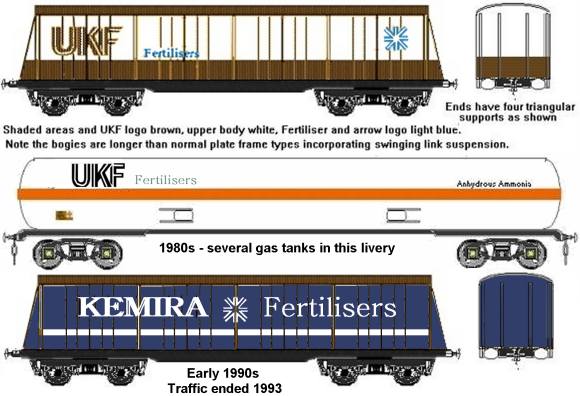
Sketch of UKF bogie van and ammonia tanker

Kemira Kemira entered the United Kingdom fertiliser market through its acquisition of Lindsey & Kesteven Fertilisers Ltd (L&K) in December 1982. L&K changed its name to Kemira Ltd in 1986. In June 1988 Kemira UK Holding Ltd was formed and in August 1988 it acquired UKF Fertilisers Ltd (now Kemira Ince Ltd) with its plant at Ince in Cheshire. Kemira is a Finnish-owned company operating through subsidiaries (the Kemira Group) in the chemical industry in 18 countries. The Group produces fertilisers, agricultural and industrial chemicals, organic fine chemicals, paints, titanium dioxide pigments and a number of other products. In the early 1990s they had an 18 per cent share of the UK fertiliser market with a major manufacturing facility at Ince (Cheshire), an ammonia plant at Hull and three blending plants at Saxilby, Sharpness and Hillsborough. The Ince plant required several million tons of imported ammonia to run at full capacity, hence the use of tank wagons for supplies. In the UK the Kemira Group manufactured fertilisers and paints and also sold chemicals, fibres and safety equipment. They stopped using rail transport in 1993 and the UK fertiliser operation was later bought out by Norsk Hydro.

Norsk Hydro (Hydro Agri) now trading as Yara (UK) Limited
This company entered the UK market in 1982 when if bought out the fertiliser business of Fisons, later buying out Kemira to become the largest fertiliser supplier in the UK.

Fig ___ Norsk Hydro 'Debauch Vite' bogie ferry wagon

Sketch of Norsk Hydro 'Debauch Vite' bogie ferry wagon

In March 2004, the company became known as Yara UK Limited following the spinning off of Norsk Hydro's fertilizer business, previously globally called Hydro Agri. In 2006 faced with a global surfeit of production they closed the former Fisons plant at Immingham.

Fig ___ Norsk Hydro and Yara logos

Sketch of Norsk Hydro and Yara logos


Companies dealing in Basic Slag


H. and E Albert
Set up around the end of the 19th, beginning of the 20th Century this was a German company who had an arrangement with various steel companies under which they set up plant at the steel works to grind basic slag for sale as fertiliser. During World War One the company was taken over by the 'Custodian of Enemy Property' in 1914 and re-established as a British Company in 1917 trading as 'British Basic Slag (Albert's Successors) Ltd.'.

British Basic Slag Ltd. (B.B.S.)
In 1917 when this company was established the various steel companies became members and took over the ownership of the plants on their respective premises. Subsequently other companies, whose interests lay in the grinding and selling of basic slag and phosphate rock, were admitted to membership. The name of the company was changed to British Basic Slag Ltd. in 1924. The company dabbled in other fertilisers in the 1920s, ground phosphate rock was sold by B.B.S. for some years but in 1926 the Board decided to concentrate only on ground basic slag or potassic basic slag. The latter, which is a mixture of muriate of potash and basic slag, was made by some of the steel companies and marketed from 1930 to 1938 but never on a very large scale. BBS was providing about half the countries needs in Basic Slag from its formation until some time after World War Two. The companies participating in this arrangement were : Shelton Iron and Steel Ltd., Colvilles Ltd., Dorman Long (Steel) Ltd., John Summers and Sons Ltd., The United Steel Companies Ltd., The Park Gate Iron and Steel Co. Ltd., The Patent Shaft and Axletree Co. Ltd. and South Durham Steel and Iron Company Ltd. The actual production and grinding of slag is the responsibility of the steel companies BBS merely handled the marketing. This organisation remained in operation into the early 1960s but seems to have gone by the later 1960s

Older companies trading in basic slag who either left or never joined British Basic Slag included Alexander Cross & Sons Ltd. (which merged with other firms to form Scottish Agricultural Industries Ltd. (SAI) in December, 1928), and Basic Slag and Phosphate Companies Ltd. whose interests and assets passed eventually to Corby Basic Slag Ltd (owned by Fisons). Others included Richard Thomas and Co. Ltd., Alfred Hickman Ltd. (a company acquired by Stewarts and Lloyds in 1920) and Stewarts and Lloyds Ltd.

Fisons
Fisons were offering 'Bilston basic slag' under their own brand from the later 1940s, the example shown is a paper sack from the later 1950s.

Fig ___ Fisons basic slag bag

Sketch of Fisons basic slag bag

Tarmac
This company has for most of its existence used considerable quantities of steel works slag in making its tarred road surfacing. In 2006 Tarmac entered the slag fertiliser business, selling their product as AGSLAG.


^
Go to top of page