Builders Yards, Timber yards and Timber 'boards'
Builders and the builders merchants both maintained stocks of materials and hence required a yard and sheds in which to store them. Larger builders maintain substantial stocks of materials in their yards but the smaller contractor buys his materials as required from a builders merchant and could have a smaller yard. Larger builders merchants were sometimes rail-connected, smaller establishments would be located fairly close to a railway goods yard. Quite often builders merchants also served as the local coal merchant, combining the two business on a single site, which makes a railway siding almost essential and makes them of particular interest to the modeller. A builders merchants would consist of extensive stores, generally single storey structures, surrounding a yard.
In the early 1930s one builders merchant advertised; Asbestos sheets, bricks, sand, cement, clothes props and line posts, creosote, doors and gates, deal and oak fencing, hardwoods, ladders, wheelbarrows, plywood, mouldings, roofing felt, slates, tiles, trellis and wallboards. In the yard one might also find a flat bottomed 'zinc' bath (for mixing plaster), black iron guttering and earthenware pipes, with the piles of bricks there might be decorative items such as wall coping stones, chimney pots and paving slabs of stone or (after the mid 1930's) concrete. The zinc bath could be made from cigarette paper glued with PVA to a base cut from postcard (painted silver then splashed with white).
A standard domestic bath can be made using the small 'bubble pack' that medicinal capsules are sometimes supplied in, although finding some the right size might take a while, and then you have to persuade the user to cut the pill out of the top instead of crushing the bubble. Trestles can be made from microstrip, guttering can be made by folding thin strips of cigarette paper along a pin and painting them black. Earthenware pipes can be made by rolling cigarette paper round a needle and smearing it with diluted PVA glue. It is best to make a single long pipe and additional small strips at intervals to represent the flared ends. When cut up with a sharp craft knife the needle can be pushed through again to return it to shape.
The same method can be used to make an open tin of paint, with a handle from 5A fuse wire, or a 'glue pot' in which wood glue made from boiled down animal hooves had to be heated ready for use. The glue pot would have a small brush handle sticking out of it.
Simple coping stones can be cut from a length of L section fine Plastruct, add microstrip at one end of each to represent the flare. Chimney pots are commercially available and the paving slabs can be cut from postcard or 20 thou plasticard. Sand and gravel would be piled in simple wooden or brick-built bunkers, sand is best represented with painted pollyfilla with some talc mixed with the paint, gravel would be fine sand, again painted to suit.
Anything liable to water damage such as cement and lime or anything expensive, such as buckets and tools, plumbing fittings and rolls of roofing lead, would be locked away in the store. Cut timber was always stored under cover, although often in open barn-like structures. Prior to the 1960's timber and wooden items, such as window frames would probably be made to order by a local wood yard, considered above but doors were a pretty standard fitting and could be stockpiled.
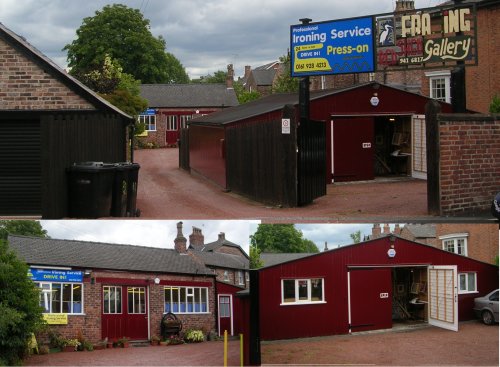
Where land was cheap a builders yard would be arranged around a large open yard, with sheds and stores and an office. The example shown below is in what is now a suburban area but when it was set up the yard was in a semi-rural location. The buildings have remained unchanged although the two business on the premises are now a picture framing works and an ironing service.
Fig___ Former builders yard
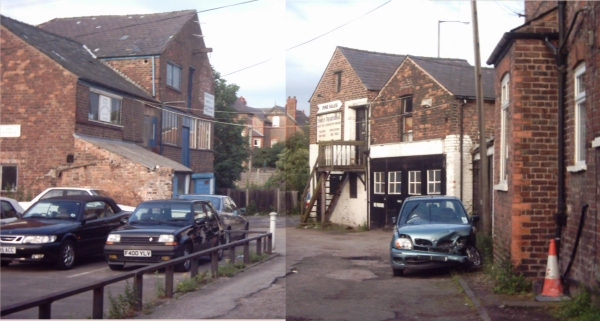
In common with most industrial structures the buildings in a builders yard tended to have bits added and removed or altered over time, producing a pleasingly jumbled appearance. The example shown below is a former builders yard (the 'street name' was until recently 'Lamberts yard') tucked in at the end of some terraced housing beside a railway bridge (on the left in the photo). Some of the housing has been demolished, leaving the small car park on the right, the low fence marks where the end wall of the terrace once stood. The buildings on the left of the yard have since been demolished. As the site was confined multi-storey buildings surround the central yard.
Fig___ Former builders yard in a built up area
Building materials provide some interesting traffic for a railway, including open wagons with pipes, bricks, slates, or lavatory pans and vans bringing casks of cement, plaster and more delicate items. Some comments on these may be found in the section on wagon loads.
Timber Yards
Note - For information on timber being moved by rail see also Wagon Loads and Materials Handling - Timber
Timber is one of the most useful building materials we have, although some skill is required if it's natural properties are to be fully utilised. With the cutting down of the forests in the Middle Ages timber became a valuable commodity. Farmers would usually set up a small wood, called a 'coppice' consisting of a selection of different types of tree, each with their own specific uses. Oak, beech and other hard woods were used for making fence rails and posts on the farm and sold to make crates, bobbins for the cotton spinners and coal tubs for the mines whilst the oak bark could be stripped off for sale to leather tanneries. Alder which grows in wet ground such as river banks is resistant to water and easy to carve, making it popular with clog makers. For structures such as pit head-gear 'pitch pine' was used and to check the timber was free of flaws the sawyer would place his pocket watch on one end and listen at the other, if he could hear the ticking there were no flaws in the wood.
Farmers would plant a group of trees of mixed types, called a 'coppice' to supply their own needs and also as a cash crop. Local records often mention the sale of coppiced trees, which would justify a mobile crane being dispatched to the local railway goods yard for this short duration traffic flow. In a local sale at about the time the railways were being built a large estate auctioned off over five hundred oaks, two hundred ash, 30 cyprus, eleven poplars, eleven sycamore and three alder trees. Many of these went to local timber yards but a number were sold off to addresses many miles away. In some locations they removed the bark in the early spring and cut down the tree in the ensuing winter to reduce the amount of sap in the wood.
In 1945 the British Forestry Commission began planting trees, mainly conifers, in an attempt to produce more home grown timber. Large Forestry Commission plantations were established, mainly in the North, consisting entirely of this limited range of trees. As of the mid 1990's however over 90% of the wood used in Britain (both timber and wood pulp) was imported. Britain still exported some timber however, both Bristol and Bootle (near Liverpool) regularly handle export timber.
Most timber is felled in late autumn when sap is at its lowest level in the tree, the leaves have fallen and the general ground cover is reduced making it easier to drag the trunks out of the woods. Timber can also be cut in the midsummer, again when the sap is at a low ebb, although recovering the wood is then more difficult.
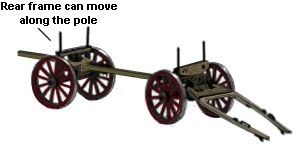
To haul the trees teams of heavy horses were used, harnessed in line-ahead. By the time of the First World War steam traction engines were being used for this work, and these were also used to haul the 'timber carriages' transporting the wood on the roads. These carriages were adjustable, allowing them to carry trees of different lengths (they were also used for transporting quantities of cut timber). The example shown is a horse drawn type, the steam-hauled type was similar but had a triangular towing frame in place of the shafts.
Fig___ Timber Carriage
Timber has its own set of units, small cut timber being sold as firewood is sold by the cord. A 'cord' of wood is a measure of volume, being 128 cubic feet. The wood was stacked about 4 feet wide by 4 feet high, hence every 8 feet was a cord. whilst the fathom (about six feet, the average distance between a man's outstretched arms) was regularly used as a unit of length and some woods were sold by the cubic fathom (a pile six feet high by six feet wide in six foot lengths). Many of the soft woods, such as pine and fir, are sold by something called 'the standard' although in practice there was more than one of these. The standard of measurement most in use is the St Petersburg standard, which contains 165 cubic feet or 720 lineal feet of II inches by 3 inches. There are markings carved into the internal posts in the 1830 Liverpool and Manchester railway warehouse (now part of the Manchester Science Museum) relating to the use of the St Petersburg standard. There was also a measure called a 'load', which varied on the state of the timber being shipped - A 'load' of sawn or hewn timber contains 50 cubic feet, and a 'load' of unhewn timber 40 cubic feet.
There are also terms for cut timber, the most important being -
Log - The trunk of a tree with the bark removed and branches lopped.
Balk or baulk - a log hewn or sawn to a square section, and varying in size from 11 to 18 inches square.
Planks are parallel-sided pieces of timber from 2 to 6 in. thick, 11 or more ins. wide, and from 8 to 21 feet. long.
Deals are similar pieces 9 inches wide, and 2 to 4 in. thick. Deal is also the term used for pre-cut soft-wood timber which was imported in large quantities from the Baltic after about the time of the First World War.
Battens are similar to deals, but not more than 7 in. wide. Pieces of planks, deals and battens under 8 feet long are called 'ends'.
Technically any cut timber that has been cut down to size is called scantling (from which the word scanty, meaning cut down or abbreviated, is derived). The term is however usually reserved for smaller strips of wood less than five inches (125mm) square in section. Timber which has been cut into strips or planks and then planed to give a smooth finish is referred to as PAR, short for 'planed all round' and is (typically) a quarter inch (7mm) smaller than the quoted size as the measurements are for the un-planed wood.
The wood or timber merchants yard has been a favourite amongst model makers since the late John Ahern's famous books ('Miniature Landscape Construction' and 'Miniature Building Construction') showed a neat and compact timber merchants yard on his Madder Valley layout.
A larger merchant in a more rural area, or one dealing with locally supplied timber, would buy tree trunks brought in by rail on long flat wagons or pairs of bolster wagons, and unloaded by crane. These were sawn lengthways into a series of strips and stacked with short lengths of small timber to separate the layers and allow air to circulate (if the log were left to dry in one piece it dried unevenly would often split). These stacks would be seen in a corner of the yard where the wood would lay for a year or so to 'season'. Once seasoned the timber would then be cut into planks to be sold and this finished cut timber has been shipped by rail in reasonable quantities for the early days of the railways.
Fig___ Stacked cut tree trunks in 1942
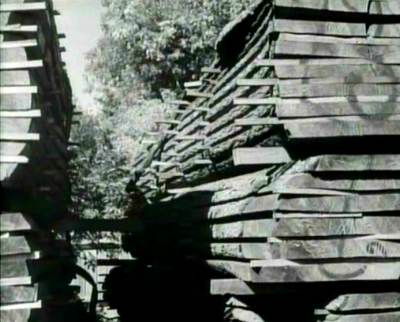
The cut trunks would be a bit fiddly to produce in 'N', one option is to build up laminates of 20 thou card, or strips of post card, with scraps of the same forming the battens between the 'slices'. The inner part would be cream coloured but the bark would still be on the outer edges of each 'slice'. Making these is very time consuming and personally I would simply assume the wood had already been further cut into planks but for accuracy a wood yard should have at least a couple of these cut and stacked logs.
In the early days of the railways tree trunks were sawn by two men, using a deep pit in the ground (called a 'saw pit) and a long saw with a handle at either end and a blade straight on one edge, curved on the other. In country areas these two man teams, with their long saw, went from place to place cutting timber for smaller wood yards and firms such as wheelrights, who often purchased a tree as raw material. The yard owner would have marked the wood to get the cuts he wanted and these men were sufficiently skilled to stay typically within a fraction of an inch of the markings. Two man sawyer teams were commonplace into the 1920s, they worked with the skilled man on top, guiding the saw down for the cut. The second man, in the pit below, was constantly showered with sawdust and could not see to guide the saw, his job was simply to throw it back up at the end of each stroke. This work was extremely hard and not terribly well paid, the men doing it had to be very rugged and often slept in the open when not on a job. Noted for drinking a lot if these two are not in the yard they might well be found sitting outside the nearest pub, if not on a job the six foot (2m) long saw would be propped up beside them. Their few other belongings would be carried in a small rucksack.
Fig___ Sawyers and their saw
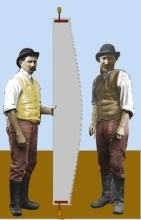
Note the blade is curved on the cutting side and the handles on the saw run across the blade, so the man on top could use both hands to guide the saw into the cut. The saw does not seem to have been wrapped or protected in any way when the men were on the move, one of them (presumably the assistant) would carry it on his shoulder.
At larger yards there were various attempts to mechanising this kind of saw, usually powered by a water wheel. These reciprocating designs were replaced by circular saws, usually under some kind of cover. I am not certain when circular saws were developed but they were in widespread use by 1900. Circular saws were originally driven by steam or a water wheel and later (since the late 1920's) by electric motors (steam remained in use into the 1950s).
The example shown below is a portable steam driven saw formerly used on a large estate, power being supplied by the traction engine used to tow it via a belt drive. Note the complete absence of any protective guards on the equipment and the length of the carriage, required to take the largest section of tree trunk the machine was to cut. In practice a really large tree would often be cut into shorter, more manageable, lengths using a two-man saw as above before being taken to the circular saw.
Fig___ Circular saw as used in wood yards
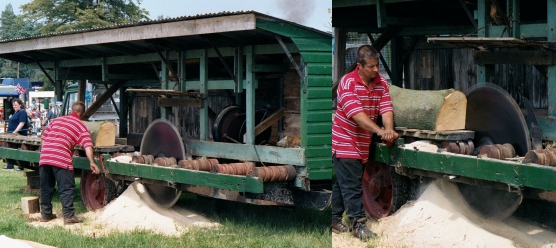
The large saw used for the tree trunks would normally be mounted in quite a large building (with open sides to allow easy access) but smaller saws mounted on a table arrangement (provided for cutting up the planks) might be in the open.
This particular tree is being 'quartered' before cutting into planks, this is usually only done with oak or other hard woods (in oak this develops the silver grain by cutting longitudinally through the medullary rays - medullary rays extend radially from the centre of the tree to the bark at right angles to the grain of the wood, they bind the annual rings together and allow sap to pass from one part of the tree to another).
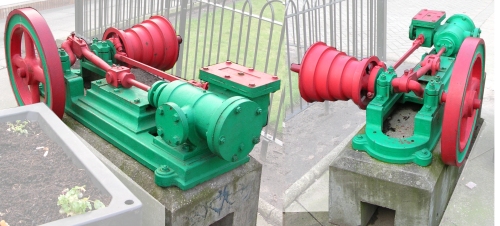
To power the saw a small fixed steam engine would often be used, this could be some distance from its associated boiler, connected by two or three inch (50-75mm) diameter iron pipes. The example shown is a typical small single cylinder engine, this one has a series of different positions on the drive belt, offering different drive speeds for saws, drills and other equipment. This particular engine is now a pavement ornament at the bus station in Bury, the flywheel is about eighteen inches (45cm) in diameter.
Fig___ Small steam engine as used in a wood yard
Bigger yards often had bigger engines, the example shown below (now mounted outside the Manchester Museum of Science and Industry) was used in a wood yard in Manchester, belt drive was used to power various saws and other equipment. This is a two cylinder gas engine, the large wheel is the flywheel (roughly five feet (1.5m) in diameter, the belt drive pulley was mounted on the plate sticking out of the side to the left in the left hand picture. The engine was not mounted in the open although the protection it had may well have been just a corrugated iron roof supported on simple posts with open sides. This particular engine was built by Messrs Crossley of Manchester (the first British firm to produce four stroke 'Otto cycle' engines).
Fig___ Gas engine used in a wood yard
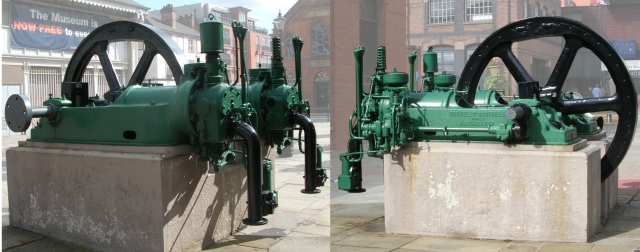
The gas used was produced from sawdust at the yard, I am not sure of the process involved but in the present context a 'shed' with a chimney and pipes feeding the gas to the engine would suffice. Gas engines of this type were first developed in the 1860s.
Once the tree is cut into strips and stacked up in the yard the actual drying takes from 20 to 300 days to get down to 20% moisture for material one inch thick (a good rule of thumb, widely used in country areas, was about a year for each inch of thickness). Beech walnut and some other woods are placing in hot flowing water or steamed first as this dilutes and washes away some of the sap, thereby reducing the drying time and darkening the wood. Kiln drying reduces the time required dramatically, from green to 6% takes perhaps 50 days and from 20% to 6% takes only two to fifteen days depending on the wood. Kiln drying also kills insects, which is an advantage over air drying however kiln dried wood has a reputation for not lasting as well as traditionally seasoned timber.
The Navy had strict rules on the seasoning of timber for use in their dockyards, for hard woods (such as oak) for baulks 24 inches square and upwards they required 26 months, for hardwoods from 16 inches to 20 inches square 18 months, from 8 inches to 12 inches square, 10 months and from 4 inches to 8 inches square 6 months. Soft woods were allowed half these periods. When the wood is required in a "dry" state for joiners' work, twice the length of time was given whilst planks are allowed from a half to two-thirds of the above time, according to their thickness.
The point of mentioning all this is to indicate just how long the timber remained in the yards, and hence how much timber the merchant would hold in stock, waiting for it to season so it could be sold. In the country yard, dealing with the tree trunks, there would be a lot of round timber stacked up ready to be dealt with as well as stacks of cut logs and some that has been cut into planks. For the logs a selection of cylindrical materials, scraps of hedge cuttings (which comes with a realistic bark), Slaters plastic rod, cocktail sticks, tooth picks, spaghetti and even scraps of cotton soaked in glue can all be used. For the planks strips of post card and Slaters plastic strip are both useful. For colouring 'wood' I use a selection of paints, mainly cream and 'dark earth' in various mixes.
After the required seasoning time in the open each strip of the log would then be cut into baulks, planks or smaller strips as per the terms defined above, the actual cuts being made depending on the use to which the wood is to be put. This would then be shipped to town timber merchants, where it would join the pre-cut imported timber.
Timber merchants tended to carry large stocks of cut timber with comparatively few uncut logs. A principal feature of a timber merchants yard are the large barn like covered drying shed or sheds, often with slatted sides and an open end, in which the piles of cut timber were stacked. The lengths were laid down in rows, often with strips of one inch thick wood between each layer allowing the air to circulate around the entire stack. In the sheds there were usually 'floors' allowing different batches to be stored one above the other, each floor would commonly hold a range of sizes as they were divided by date rather than size.
Hence you will need a lot of strips of 'wood' (for which bulk-buying Slaters Microstrip is the best option in N, in larger scales you can use 'lollypop' sticks or fire-lighting wood 'spills' although the latter are now hard to find and often brightly coloured.
In some locations the timber merchant dealt with everything from the logs to the cut timber, the compact wood yard on Mr Ahern's Madder Valley layout is of this type, located in a small town in a rural area. Larger town timber merchants might also have the facilities to process fresh cut timber, although the cost of the land required for seasoning counted against this.
A crane or two is pretty essential in any wood yard or timber merchants, tree trunks being too big to man-handle. Simple fixed hand cranes of the type used by the railways in goods yards were commonly used. In a larger yard there would often be a small but self propelled, rail mounted, steam crane used to handle the heavier logs and baulks. This was not running on the siding rails but would have its own section of line not connected to the railway proper. See also Wagon Loads and Materials Handling - Materials Handling - Hoists and Cranes for more on cranes and hoists.
Finally there would be a store room, where spare parts for the saw mill and what have you would be kept and the 'office', which might be a small lean-to structure beside one of the other buildings.
Wood decay is caused by fungi, a water content of less than 20% reduces the problem and treatment with a toxic chemical stops this. Typical impregnation plant consisted of a pressure tube 50m long by 3m diameter with heavy doors on either end, dogged all round, and a light rail track running through it for cradles to carry the wood. There would also be associated storage tanks, pumps, boiler house & other auxiliary equipment. This would only be seen at a larger timber merchants yard and I have found no references to it prior to the 1920s but it would justify the arrival of tank wagons on the associated sidings.
Fig ___ Wood Yards
The seasoned cut timber is sold locally and shipped off to timber merchants in the towns, who stack it in the large open barn like structures mentioned above. At a town timber merchants, where much of the timber arrived pre-cut and the turn over was higher, the division of the stacks would be mainly based on the size of the timber. From photographs it is apparent that a lot of wood was stacked in the open at all timber yards and merchants, particularly in larger yards. Ratio now offer a suitable building in their range and in towns several of these sheds might appear along a siding, usually standing on a loading bank equipped with a crane or two. By the early 1950s most merchants yards seemed to have a lot of timber propped up against the walls surrounding the yard, although this would induce a curve into the planks.
Fig ___ Timber Merchants yard
Industries such as furniture making would routinely buy their timber direct and a railway siding at a larger furniture factory would not be improbable.
Imported Timber
Timber is grown all over the UK but lot of timber has been imported since before the railways were built. Imported timber includes tropical hard woods as well as the Scandinavian soft woods and most is cut and processed close to the ports. The term soft woods has nothing to do with the hardness or otherwise of the wood, it is a term applied to the wood from coniferous trees, pine, spruce, fir and hemlock. Having said which the wood from the centre of the tree (known as 'heart wood') is harder than that on the more recently laid down outer layers (known as 'sap wood').
A lot of imported timber has been shipped pre-cut, this was the norm by about 1900, and a long rake of open wagons loaded with timber would regularly emerge for the docks specialising in this trade. Peco offer a 'wagon load' of cut timber planks to suit their five plank open wagon and Bryant & May sell 'extra long matches' that make a good load for bolster wagons. Cut timber was a fairly common cargo on the old train ferries from Europe and may now be moved through the channel tunnel.
Imported pre-cut timber was always marked and by the early twentieth century these markings were fairly standardised in design and colour, although of little practical interest in N a tiny dot of colour can be added to a model if required. Norwegian timber was stencilled with the shipper's initials in blue letters painted on the ends. Swedish timber was stencilled with red letters or devices, the inferior qualities in blue. Prussian (German) timber was scribed (the symbols being cut into the wood rather than painted on) on the sides near the middle. Russian timber shipped down from the Baltic was dry-stamped or hammer-branded on the ends. Canadian timber was stencilled in black and white whilst United States timber was marked with red chalk on the sides.
Wood under water is less liable to rot as there is less oxygen available so larger baulks of imported timber would be floated in the dock when they arrived until they were to be shipped. A large crane would then be used to lift them out of the water and transfer them to timber wagons.
Pit Props
Pit props were a regular cargo into mining areas, they were generally imported until recently, notably from Poland and Scandinavia, but since the 1980's demand has been met from domestic sources. There is a large firm in Nottingham, another in Scotland and until recently the Forestry Commission was also a supplier. By the late 1980's transport was almost exclusively by road but they are easy to model; roughen a length of 1mm diameter spaghetti, paint this with thinned light earth and when dry give it a going over with dirty thinners or very thinned black then cut it into 20mm lengths. You need about three to four strands of spaghetti for a wagon load. See also Wagon Loads and Materials Handling - Timber.
Veneer and Plywood
Wood veneer has, since the later 1920s, mainly been produced in large factories. Veneer can be made in two ways, you can press the side of the log against a rotary cutter or you can take slices from the log, rather in the manner of a carpenters plane. Sawing is not used as it too wasteful (the sawdust has no value). More than 90% is rotary cut but wood for decorative use is often sliced. Veneer can be produced in the range from 0.6mm to about 8mm in thickness.
Plywood was developed in the 1920s and consists of a series of layers of veneer (always an odd number) glued together to produce a single thick sheet. The grain in each layer runs at right angles to those either side and the resulting material is stable and resistant to warping (in many applications it is superior to metals having a greater strength for a given weight and a lesser thermal expansion). When it was first invented plywood was made using animal, casein, soybean or starch for the glue but in the 1940s better synthetic glues were developed (phenol or urea formaldehyde), producing 'exterior quality' plywood suitable for use outside (one example being the bodies of railway vans). Plywood was shipped in considerable quantities from the mid 1930's, often in vans but sometimes in sheeted open wagons, the standard size of eight feet by four feet was established fairly early on and was the norm by the end of World War Two (this standard size set the dimensions of the highly successful Ford Transit van load area).
These days the most common glue used is either is phenol-formaldehyde or resorcinol-formaldehyde, producing plywood which is resistant to heat cold, water, steam and dry heat. Formaldehyde, familiar to most as a preserving agent used by funeral directors, is itself an important chemical, roughly the 25th highest volume chemical produced today. A gas in its pure form it is shipped dissolved in water with a spot of methanol added to stop it setting solid. It is used to make 'permanent-press' crease resistant fabrics and also forms the basis of the urea and melamine resins, commonly associated with modern replacement windows and kitchen fittings.
Fibreboard (hardboard) and Chipboard
Fibreboard or hardboard is made in a similar way to paper, mashed wood pulp being squeezed into flat sheets between heated rollers, the rough edges of the fibres binding the whole together (the same principle used to make felt from animal fur). To make it more weather proof it can be impregnated with linseed oil producing so called 'exterior grade hardboard'.
Cheap un-barked wood is pulped (modern methods include explosive pulping where a high pressure steam/wood mix is allowed to escape through a 'gun', expanding explosively as it does so). Additives are put into the mix before sheet formation. The two basic process in sheet formation are wet felting and air feting, in former glue is not used, in air felting a glue (synthetic resin) is added in ratio 1-4%, other additives include rosin, paraffin wax, and anti-microorganism chemicals.
Particle board or 'chip board' (basically shavings, splinters and flakes of wood mixed with glue and pressed into a single flat sheet) was developed in the 1940's (when suitable 'resin' type glue became available) and its use has rapidly expanded ever since. This material was made possible by development of synthetic resins, it uses the residues from other wood industries including forestry and also uses bark which formerly had little value.
This material makes far more efficient use of timber, as against a tree has had the bark removed (10-15% of the volume) and has been sawn into planks then planed into shape and had the joints and trimmings cut away only about 25% of the tree gets used. With particle board anything up to 80% or even 90% of the tree ends up being productively used.
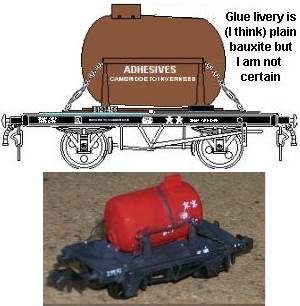
The finished product is shipped in sheets eight foot by four foot, mainly in vans. Traffic into a chipboard factory would include tanks of the resin glue used, BR used some ex-beer de-mountable tanks for this in the 1950's and 60's (see Fig ___). Modelling these wagons is discussed in the section on 'Kit Bashing' under 'H - Various types of BR era demountable tanks and wagons', the model shown is liveried for use with beer, I believe the glue tanks were bauxite.
Fig___ Model of a demountable tank as used for resin
^
Go to top of page