Return to index page

Pottery and Bricks


Bricks tiles and pottery are all made from clay. Clay is made up of fine grains or shales, similar chemically to slate but with a finer structure (technically brick making clay is hydrated silicate of alumina but there are always impurities in the material, notably iron, calcium and magnesium). This material dates back to when the Earth was formed and geological processes have changed the material from a form of rock to what is in effect a powdery material. Clays are also produced by sedimentary deposition and shales are slay which has been subjected to intense pressures often rather similar to slate. There is a special category of clay known as 'fire clay' which is found at greater depths and which produces goods which are resistant to heat, the bricks made from the material are called refractory bricks (widely used in making ovens and kilns). If you get rid of the water in clay you get a hard material that can withstand rain and the like, in Medieval times bricks were made by forming clay and allowing it to dry out under cover for a couple of years, in hot countries sun dried bricks remain in use tody. To make clay really waterproof (to make brick or pottery jugs etc) you have to cook the clay which drives out more water and causes a number of complex chemical changes in the clay. This process is technically called 'vitrification' and the resulting material will not return to clay when wet. Heating the clay in a kiln or oven produces what is known as 'burnt clay', the technology has existed for thousands of years and a brick layer is technically a 'burnt clay artist'.

The kilns used for firing clay are discussed in more detail under 'Lineside Industries - Prototype industrial ancillary structures - Kilns'.

The two main forms of burnt clay which would qualify for a rail connection are potteries and brick & tile manufacturers. Bricks are strong, durable and virtually fireproof, they remain a vital building material today, although many buildings now have a structural framework of steel. A lot of brick making in Britain was a seasonal activity into the 1960s. By the time the railways arrived pottery manufacture had become semi-industrialised and was a year-round occupation.


Pottery Manufacture

Pottery covers not only pots, plates and jugs but also domestic lavatory pans, basins and sinks, electrical insulators for telephone or power cables and motor car spark plugs, bricks (discussed separately) and tiles for interior walls, floors and for roofing.

Chemical works often used glazed pottery containers for moving corrosive liquids about the place, one common type was the acid egg which were usually fired on-site. The device was in effect a non mechanical pump, the acid was poured into the container then pushed out down a delivery pipe using compressed air. There were also large egg shaped pottery 'acid jars' used to move acids about from place to place (illustrated in the section 'Lineside Industries - Chemicals and Plastics').

Pottery is basically clay which is then cooked in a kiln to form a rigid material that does not soften when immersed in water.

Basic clay pottery, called biscuit ware, has a rough surface, to make this smooth a glaze is added. The glazing consists of a thin layer of glass deposited on the material by vaporising glass producing minerals in the kiln. Some time in the seventeenth century potters in Germany discovered they could add a waterproof glaze to pottery just by adding salt to the kiln in which the pots were fired. Potters in Staffordshire adopted the technique and this laid the foundation of Staffordshire as the main centre of production in the UK. Other glazes are applied as a liquid and cooked onto the surface in a second firing at a lower temperature than the initial 'biscuit' firing. One common glazing material was galena (Lead Sulphate, the ore from which lead is obtained).

Wedgewood is the most famous firm in the industry, largely because the founder was the first to reproduce 'porcelain' using 'China clay'. Porcelain is also known as 'China ware' as the secret for making it had originally been discovered by the Chinese about a thousand years before, China clay gets its name from its use in making porcelain.

To make earthenware several ingredients are required, non of which are found in Staffordshire. China clay and Cornish stone come from Cornwall, stuff called 'ball clay' comes from Devon and Dorset whilst flint pebbles can be found in Kent. Cornish stone contains feldspar, which lowers the temperature at which the clay will harden. Feldspar is potassium aluminosilicate, the most common form has a little sodium in it as well. Ball clay has good plasticity, strong bonding power, high refractoriness (heat resistance) and fires to a white or cream colour. Most of these raw materials traveled by water, round the coast then via the canals to the pottery towns. Earthenware and pottery all regularly traveled by canal, where the smooth transit saved on breakages, and Staffordshire was soon the principal hub of the British canal system.

The China clay is too stiff to be used alone so it is mixed with the ball clay, however the resulting mix would tend to crack as it cooled and shrank so a powder made by heating and then grinding flint is added. All the ingredients are mixed with water to produce a slurry called 'slip', this is either squirted into moulds or partially dried and squeezed into moulds to make the wares.

After drying for a time the wares are taken to the kilns, the first firing is called the biscuit firing and the rough pottery that emerges is called biscuit ware. The glaze is then added and a second firing at a lower temperature fuses this to the surface.

Electrical insulators are made using China clay, ball clay, feldspar and pure sand, the sand improving the electrical resistance of the material.

Stoneware is waterproof and opaque, it is partly vitrified, that is heated to a high temperature to form something like glass and has a smooth shiny finish. Prior to mechanised glass bottle production the stoneware jar was popular for beer and soft drinks. These jars have one advantage over glass in that the upper section can be left un-glazed, permitting the liquid inside to evaporate from the surface and hence cooling the contents. After about the 1850's most beer, wine and spirits was shipped in bottles but the 'stoneware' jars proved popular for a wide range of other liquids such as inks. By the 1850's machines were being used to form stoneware items, one common application was field drains (about a foot in diameter with a raised ring at one end to fit over the next section. Up to the 1950's soft drinks notably ginger beer were often sold in screw-topped light brown earthenware bottles (commonly called 'jugs') which had been mechanically formed. These generally held about a gallon (four litres) of liquid and there was a deposit on each one. Smaller earthenware bottles of a similar design were regularly used for lunch boxes, often filled with beer.

Terra Cotta is unglazed, usually brownish red earthenware

'The Potteries' in the north of Staffordshire were the centre of British pottery manufacture, extending over an area of only nine miles by three in the upper Trent basin encompassing the old towns of Burslem, Hanley, Longton, Stoke-on-Trent, Tunstall and Fenton (all except the latter being the 'Five Towns' of the Arnold Bennet novels). In 1910 these towns were amalgamated to form a single municipal borough under the name of Stoke-on-Trent which became a city in 1925. Newcastle-under-Lyme although not associated with pottery manufacture may be regarded as a part of the district. Wedgewood's new works of 1769 at a place he named Etruria used steam power to drive the flint, clay and colour mills and this firm probably more than any other transformed pottery from a craft into an industry. The local coarse clay and locally mined coal formed the basis of the industry but all the other materials were brought in by rail, notably the quantities of China clay from Cornwall. Up to the 1980s at least Staffordshire remained one of the worlds principal pottery producing centres, however in 2009 an American firm bought out the last major firms in the area and shifted the bulk of production of Royal Doulton and Wedgewood to Indonesia.

Men working in the potteries and chemical trades, along with woman and all children under the age of 18 in all industries were the only ones who's working hours were determined by law.

The distinctive urban industrial quality of the area has its attractions, however making the huge brick 'bottle kilns' for layouts depicting the era before the BR corporate blue livery appeared represents something of a challenge. Bottle kilns (see also Industrial buildings and ancillary structures - Kilns) were used all over the country, according to a postcard in a friends collection there was at least one as far south as Honiton (in Essex, near the south coast). The illustration below left, based on a photograph taken in the 1930s, shows a typical pottery, points to note are the scale of the kilns (compare with the figures on the pavement) and the heavy stone posts by the entrance to protect the brickwork. Fortunately you can compress things rather a lot and retain the general atmosphere. The version on the right has the kilns reduced by a third, the surrounding buildings are reduced in height slightly to compensate, and the result is a much more compact scene.

Fig ___ Typical small pottery
Sketch showing typical bottle kilns at a pottery


The illustration shows the two common types of 'bottle kiln', the cone shaped type to the left is the older design, the more bottle shaped example on the right is more recent. Some of the cones were rather tall and slender, the example shown is about average. These old kilns gradually disappeared from the landscape from the 1930's on as the potteries changed from coal to gas and electric firing in the 1920's and 30's (thanks to cheap gas supplies from the Shelton Iron Steel and Coal Co works situated between Etruria and Hanley). Only about a third of the kilns were coal fired by the end of World War Two but these old kilns were not taken down at the time and dominated the landscape well into the post world war two ere. They were finally demolished in large numbers from the 1960's on and by the 1970's there were only a few preserved examples left. The last firing of a bottle kiln was a specially arranged one-off (for one thing it contravened the clean air act) done at a preserved kiln in Staffordshire in 1982, this was filmed for posterity.

An early type of kiln used for pottery and brick making was the 'bottle kiln', early versions of which were often not very bottle shaped but more like a slender cone. One problem in modelling the more curvaceous bottle kilns is their sheer size, although modelled to scale they would probably look too big to anyone who had not actually stood next to one. Bottle kilns were not all the same size however and on the same site there might be two close together one only two thirds the height of the other (see Fig ___). Making a curved type bottle kiln is difficult, I remember an article by Alan Downes in the model press which mentioned that he had managed to get a potter to run one up for his layout. I enquired locally and would suggest a potter would probably charge between thirty and fifty pounds to model a couple of kilns in N scale. Another option is to have them turned up out of wood and a third option is to find a plastic bottle with a suitable shape but all of these leave you with the unenviable task of adding the brickwork. The bottle kilns I made many years ago for a small pottery on an N Gauge layout were plastic 'party poppers' coated in Milliput.

If you cannot find a potter, wood turner or suitable bottle all is not lost, you can make the thing out of cardboard. Cut a full-size silhouette from a stack of perhaps five postcards, the top one or two centimetres should be omitted. Each of the resulting shapes would then be folded in half and all the folded edges would be glued together. This forms a set of vertical 'ribs' to which you add a short length of card formed into a tube to the top. Cover the lower ribbed part with tissue paper soaked in glue to give you the basic shape then coat the whole thing with Peco modelling clay, Milliput or fire cement and smooth to shape.

When dry either cover with brick paper strips or scribe in the brickwork. To scribe the horizontal course lines hold the knife on a block of wood and rotate the model against it, then use the tip of the knife to add the verticals. To make life easier you can build a simple straight-sided cone shaped kiln, the drawing below right is of a kiln at Longport alongside the Trent & Mersey Canal.

The associated buildings could be from any source, the Bilt-eeze card kit of a 'Stone Smithy' would do for example, I used two of these for my small pottery.

Fig ___ Bottle kilns
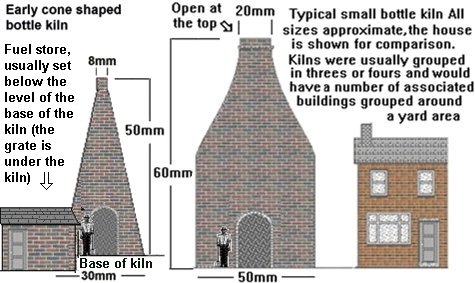
Sketch showing typical bottle kiln as used for pottery and clay tiles

The visible 'bottle kiln' is in fact an outer shell, the kiln itself was a similarly shaped structure built inside with perhaps four foot clearance between the two shells. The entrance was about seven foot high by five foot wide, coal went in in wheel barrows and the pottery went in in large fire clay trays or basins (perhaps three foot by two foot by a foot or so high) called 'saggars'. The saggars were lined with some crushed flint to prevent the pots sticking to them, once filled they were stacked up inside the kiln and the fires were lit. Even with the flint dust lining the new pots tended to stick to the bottom of the saggars and there was an actual job title of 'saggar makers bottom knocker'. This chap was employed to hit the bottom of each saggar as it was lifted out of the kiln. He used a wooden implement to break away the plates, cups or jugs inside, some skill being required to do this without breaking the saggar or the new pots themselves.

For a model layout we can assume that the front of the pottery is at the far side, all we need are some buildings facing into the yard and a kiln or two. The example shown is about as small as you can go, although using a bottle shaped kiln rather than the cone type would reduce the footprint somewhat. The associated buildings often blended into the kiln wall, however that makes modelling rather more difficult and some were free standing as shown. Do bear in mind that your hand has to get into the yard to deal with couplings and the like. The company name might appear in the brickwork on the upper part of the right hand end of the building.

Fig ___ Example model pottery
Sketch showing typical small  pottery for a layout


Brick, tile & clay pipe works

Note: This section describes the more common bricks made from clay and these still represent over 80 percent of the bricks used in the UK. Since the Second World War non-clay bricks have been developed; 'calcium silicate' bricks are composed of a mixture of lime and sand, or gravel (typically 90 percent of the brick is silica sand), they are hardened by steam in an pressurised autoclave. The chemical process by which the resulting brick is formed is not yet fully understood (well it wasn't in 1986) and the bricks are white, grey or pink in colour (depending on the sand used). Concrete bricks are composed of natural or manufactured aggregates, bound with cement, and are usually dried in a heated chamber although this is not strictly required as such bricks can be left to dry naturally. The factory making any of these would be a large shed structure. The sand lime type are presumably built where the sand is available but might receive shipment of lime. The concrete brick factory would receive shipments of cement and aggregates (broken rock or gravel).

Clay bricks have been around for a long time, according to the Old Testament the tower of Babel was built of bricks. In hot countries the sun can be used to harden brick, in Britain although simple sun dried bricks have been used for thousand of years the brunt clay type is preferable. The burnt clay brick we know today was introduced by the Romans in about 43 AD, although Roman bricks were smaller than the more familiar modern type. After the Romans left burnt clay bricks fell from use for many years as other construction methods were cheaper and produced acceptable building for a largely rural population. Following the Great Fire of London in 1666 most buildings in the Capital were built of cut stone or brick walls to reduce the risk of fire. The first regulations regarding the size of bricks were introduced in 1729, these were thinner than modern bricks but they were all to a standard size.

Most bricks are made from clay and there are several areas in Britain with suitable deposits. The three types used are:
Surface clay, which is usually dug out from large pits.
Shale, which is made up of clay which has been compressed into hard flat layers (left long enough it forms hard slate). Sometimes found at the surface shale was also mined.
Fire clay, used to make refractory bricks which can withstand tremendous heat. The fireclays are made from materials such as silica sand or dolomite, this is seldom found near the surface and one common source of refractory material was sand lifted out of coal mines which contains a lot of alumina. This stuff, when made into bricks, can withstand tremendous heat and allowed the development of better retorts and furnaces

The nature of the clay or shale determines the properties of the bricks produced, it is often necessary to add something like sand to the clay mix to prevent the bricks distorting as they are heated.

Permanent brick works were always built on or very near to a source of clay or shale, firms established in sites where this material ran out went bankrupt. Generally it was held in the 1960s that 20 to 25 years supply was the minimum acceptable productive life of a new works to cover the capital cost of establishing the works and the works should ideally produce about 25 million bricks a year for the most economic operation. It takes about three cubic yards of clay to make just 1000 bricks, so the 25 million a year would required some 75,000 cubic yards of clay to be recovered (which is a hole about 200 feet square by sixty feet deep).

Also the clay needs to be of a suitable type to make a good brick and many buyers would be wary of a new source of bricks. As a result the size of brick works increased steadily after the 1930s, although many smaller works remained in production into the 1970s and a few (producing specialised goods) into the early 21st century. In the early 1970s nearly two-thirds of non-fletton bricks came from works producing less than 25 million bricks a year.

Most clay was recovered in large open pits, although some (notably fireclay) was recovered from mine waste or purpose built mines (usually of the 'drift' type) as this material tended to lie deeper in the deposit. In some areas the clay was deeper underground and the most economical approach was to sink a mine to recover the clay, these were usually of the 'drift' type. Coal mines often encountered a layer of suitable 'shale' material and several set up a brick works on the site to make use of what would otherwise just be waste product. The sketch below is very provisional, it shows a colliery operated brick works wagon sketched from a photo taken in about 1910. This works used a Hoffman kiln (discussed below) close by the loading bank.

Fig ___ Tredegar Brick Works
Sketch showing typical brick company wagon

The clay was originally moved from the pit to the works in wheelbarrows and horse drawn carts but by the 1920s the most common method was light railway tippers, typically on 15 inch gauge track, often ex War Department (now called the Ministry of Defence) kit left over from World War One. The standard type, a triangular section side tipping wagon, could hold a cubic yard of material. They used stationary engines and cables to haul the skips up out of the pit to the factory, by the 1920s they were using small steam or (more commonly) petrol engined locomotives for hauling the tippers and other wagons about the site. From the later 1920's larger works sometimes used an aerial rope-way, on of these (possibly the last) is still in use (2008) at a brick works in Lancashire. In the 1930s giant drag line excavators, feeding the factory via a conveyor belt appeared at larger brick works. In the post-war era belt conveyors (first used in the 1930s) were increasingly common at larger works but smaller establishments, and some medium sized sites, continued to use the little petrol locomotives running on narrow gauge tracks.

In O gauge and larger scales there have been many models produced based on the light narrow gauge equipment seen in smaller quarries and in brick works. There is a firm called Black Dog Mine that offers 'O' scale kits to fit on 'OO' and 'N' scale mechanisms but replicating this in N gauge is more difficult due to the tiny size of the engines. The driver sits sideways, so he can turn his head to look either way, the seat is against the side of the cab, the entrance is on one side only. The example shown below is actually quite a large and 'posh' loco, many were smaller and had no upper sides or roof on the cab.

Fig ___ Typical small loco and side tippers used in smaller brick and tile works
Sketch showing typical small loco and side tippers used in smaller brick and tile works

Up to the mid 19th century only the softer surface clays were regularly used. These were dug out and piled in heaps for a winter, so the frost would break up the deposit. This was then dug out the following summer, spread on the ground and trampled by men to prepare it for moulding. In the mid 19th century someone came up with the 'pug mill', a vertical 'barrel' with no top or bottom, this had a vertical revolving shaft carrying blades to break up and prepare the clays. They were originally driven by a horse powered 'gin' (see also 'Appendix One - Engines and Prime Movers') and were sometimes set up in a permanent octagonal building with large open sections in the walls. Some of these mills remained in use at older small works into the early 1930s.

Fig ___ Typical horse powered 'pug mill'
Sketch showing typical horse powered 'pug mill' used in smaller brick and tile works

The use of the pug mill meant the clay did not have to be left out to 'winter' (when the frost broke up the material) but the stone still had to be removed. The simple vertical mill was developed into a horizontal type and adding iron rollers to the horizontal mill allowed the use of harder shales and marls. Once the clay had been ground (and stones removed) water was added to make it the right consistency for moulding (known as 'puddling' the clay at some works).

A good brick maker could hand-mould about 900 bricks a day using simple wooden boxes (hand moulding is still used today for some types of brick). The standard 'London Stock Brick' is (or was until the 1960s) a hand formed brick, these are mixed with chalk to produce a yellow brick (those with no chalk come out dark red). During preparation of the bricks some of the fuel is added to the mix, when this burns away it leaves a pourous brick that is light in weight but remains strong.

At any larger works built after the 1920s the 'pug mill' will be a two-story affair with the light railway feeding into the upper floor (often on quite a steep ramp with a winch at the top) and an associated tall(ish) chimney for the boiler supplying the power (see sketch below under 'modelling a brickworks'). The actual mill is mounted on the upper floor with the brick press, extruder or hand forming area on the ground floor of the building. The boiler chimney was often left standing after the conversion of the machinery to electrical power (mainly after the 1930's and after World War Two at smaller more isolated works).

At some point it was realised that you could make the hole at the bottom of the mill 'brick shaped' and as the clay was extruded he could cut it to 'brick' sized lengths using a wire. By the 1930s they had turned the mill onto its side (the 'horizontal pug mill'), this worked like a sausage machine, extruding a long strip of clay on to a 'table' of rollers. By this time steam power was the norm and the entire process was mechanised with a multi-wire frame cutting perhaps 10 bricks at a time. This is known as the 'stiff mud' method.
In the later 1930s they developed the 'soft mud' method, which uses a wet clay mix poured into metal moulds which are then emptied onto a drying frame. By adding a coating of water or sand to the moulds the decorative finish can be achieved.
Most expensive of all is the 'Pressed ' type, in which an almost dry mix is compressed into a frame, resulting in denser and hence stronger bricks. A typical brick press machine from the 1930s would turn out about 3,000 bricks an hour.

In areas where the ground was mainly hard rock stone continued to be the main building material but as coal mines reached deeper into the earth they often encountered a rock called 'shale'. This can be pulverised and used in place of clay to make bricks and by the mid nineteenth century many collieries had set up brick works to make use of this otherwise waste material. Relatively cheap bricks from the colliery then replaced stone as the main building material in the area. They used powered 'drop hammer' pulverising mills prior to the development of the horizontal pug mills (described above) in the 1930s. As recently as the 1940's brick works have been set up at collieries to utilise the waste shale from the associated tip, sometimes this was done after the colliery itself had closed down.

Brick works were essentially using a fairly standard set of kit by the mid 1930s, heavy rollers to break up the shale, a horizontal trough mixer in which knives broke up the shales in water, the pug mill where the clay was mixed to the right consistency and a set of wire cutters to chop up the extruded section into bricks. There are aspects of the chemistry of clay that are not yet fully understood, for come clays it is best to divert the clay just before the pug mill and allow it to stand for a couple of days before proceeding, the last I heard no one knew why this made better bricks.

Mechanical production methods had been introduced in American brick works in the mid nineteenth century but British works only appear to have applied steam power on any scale after the 1880's. Machine made bricks are often moulded with a recess (called a 'frog') or a series of holes in them to reduce the weight, making life easier for the 'brickie' but more importantly reducing the raw material and shipping costs.

The clay brick shapes contain too much water to be 'fired' (typically about 20 percent by volume, about half a pint), this would turn to steam and break them apart in the kiln so they have to be dried out. Up to the early 1900's this was usually done by laying the bricks out in the open all sitting on their sides. This was a very time consuming process, in some areas it could take two years for the bricks to dry enough for use. By the early 20th century the bricks were being stacked to dry in simple stacks perhaps ten bricks high protected by a light shed (often just a roof on legs), this drying area would be quite large.

In larger works however it was found economical to build drying sheds in which the clay bricks were laid on racks and bathed in hot air for a couple of days (waste heat from the works boilers was redirected through the sheds). In the early 20th century 'tunnel dryers' were developed, in which the bricks travel through a heated tunnel on small trucks. This proved to be less than successful however as such rapid drying cause the bricks to deform badly unless the clay was of a rather particular type.

Once dried out the brick shaped clay blocks (called 'green bricks') are stacked on trolleys, or piled on 'brick barrows' and taken to the kilns where they are stacked by hand to be 'fired' or baked. The actual stacking required some skill, layers of already fired bricks were sometimes included in the stack as these reacted to the heat differently and controlled how the heat inside the kiln was distributed.

Where deposits of clay were too small to warrant a permanent works an simple method of 'firing' the bricks was to pile the dried bricks in stacks, called clamps. Small sized coke and coal was packed into spaces between the bricks and the whole stack was covered in turf and set on fire. This technique was confined to the country areas where bricks were produced in small irregular batches for local consumption only, hence any rail connection is unlikely, but it was used in the South of England at least into the 1950's. For a permanent brick works they built a kiln, which used a lot less coal and produced much more consistent results. Kilns are discussed in the section 'Lineside Industries - Prototype industrial ancillary structures', the notes which follow apply only to brick works kilns.

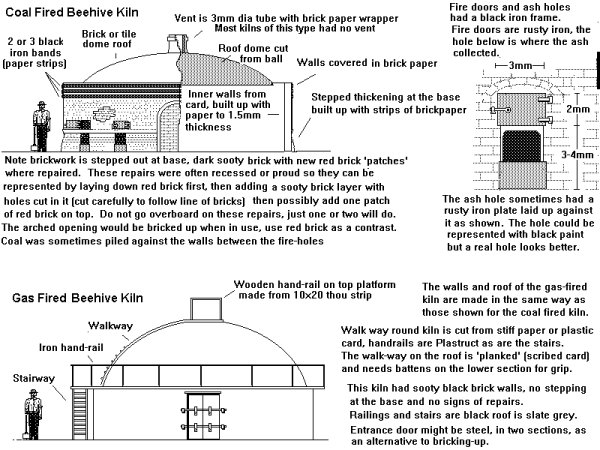
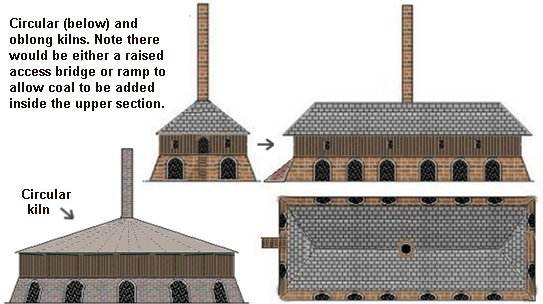
The earlier kilns were the open topped semi permanent 'Scotch kiln', a rectangular building rather like a toy train set stand-alone 'tunnel' with arches set into the sides and no roof. By the 18th century they were using tall cone shaped kilns (similar to the type shown for the pottery above) and later the more bottle shaped type were also used, but in the early 19th century someone came up with the 'downdraught kiln', the most common type being the igloo shaped 'beehive' kiln which was widely used in brick making as shown below. Not shown in the sketch are the coal heaps that would be close to these kilns, often with small piles beside the firing ports round the base.

Fig ___ Beehive kilns
Sketch showing typical beehive kiln as used for bricks

In a typical 'beehive' downdraught kiln, typically about thirty feet in diameter, four men took two days to load up 12 hundred bricks, the fires took two days to get the chamber up to temperature, another day and a half to fire the bricks then two days to cool down. The unloading again took four men two days. This type of kiln has remained in use to the present day as it can be handy for an odd order of non standard bricks or pipes. These traditional types of kiln do not heat the stack evenly, the bricks on the outside tend to be a pale colour, the inner band dark red and those from the centre can be fired to hard blue engineering brick (assuming the right clay is used) all in the same kiln. If you bang two of the hard blue bricks together they will 'ring'.

Coal and gas fired kilns of this type remained in use at small brick works into at least the 1950's and some small firms were still using scotch kilns in the mid 1990's, one or two sites are still operating beehive kilns in the early 21st century.

In the 1930's some beehive kilns were supplied with 'producer gas' burners and gas supplied from the mains has also been used (the first to use mains gas were the potters in Stoke because the local steel works was supplying cheap gas to the Corporation). Since the later 1960s the use of mains gas spread to many brick works as (at the time) gas was cheap. The illustration below shows a post war scene, based on photographs taken in the 1960s, which shows a foot thick dull grey pipe run between the tops of the kilns, the purpose of this is not clear but it may have allowed pre-heating of one kiln from the waste heat of another. The kiln in the foreground was a coal fired type but has been modified for gas by adding a double run of 2 inch pipes round the base, feeding the former coal fire holes (or rather the ash pits below these). Part of the modification appears to be a metal trunking run around the top of the walls.

Fig ___ Post war beehive kilns
Sketch showing typical post war coal and gas fired beehive kilns as used for bricks

The next stage was the 'tunnel kiln', which looks very like a Scotch kiln but it has a solid roof. These roofed beehive and tunnel kilns had a problem with the roof spreading as the kiln was fired, the beehive type had iron bands around them near the top and the tunnel type often had a hefty (9 inch or 20cm) I girder built into the upper side and vertical I girder posts at intervals along the sides, connected across the top by steel wire or chains. The tunnel kiln has multiple chambers and uses the hot waste gasses from firing one chamber to pre-heat the next, which saves a lot on fuel costs. I have seen a lot of these labeled as Scotch Kilns but the two are different in principle, the tunnel kilns being of the 'downdraught' type, clues are the reinforcing posts along the sides of the tunnel type and the associated chimney. The examples shown below re typical, the kiln shown bottom right is based on the Madder Valley model (for more info see also Lineside Industries - - Prototype industrial ancillary structures - Kilns')

Fig ___ Tunnel kilns
Sketch showing typical simple tunnel kiln as used for bricks and tiles

In the 1860's a new type of tunnel kiln appeared, the Hoffman kiln (see Fig ___). which is a tunnel kiln built in a loop so it can run continuously. These have remained in use certainly into the 1990's and possibly still today. Whereas a single beehive kiln might produce a quarter of a million bricks a year a large Hoffman type tunnel kiln could turn out seven million.

Fig ___ Hoffman kiln
Sketch showing typical Hoffman kilns as used for bricks

In America mechanisation has always been favoured and in about the 1880's they started building 'linear tunnel kilns' in which the bricks are placed on steel trolleys and carried through a series of heated chambers at progressively higher temperatures. The theory behind the linear tunnel kiln suggested they should offer advantages but early designs were not a great success and they did not become popular in Britain until after the Second World War. Part of the problem was that the bricks were still largely man-handled into the kilns, from the kilns to the stock-pile and onto the lorries and railway wagons. This mitigated against mechanisation as the equipment cost money and the labour force would simply end up with free time with no benefit for the works.

Although mechanisation at British works was limited they did use light rail systems to move the bricks about, the example shown below has an overhead electric powered loco moving the wagons of bricks from the brick press to the kiln (replacing the brick barrow method), however notice that the track laid into the kiln is temporary, supported on wood and old bricks. This entrance would be bricked up or sealed with iron doors for firing the chamber.

Fig ___ Loading a Hoffman kiln by hand
Loading a Hoffman kiln by hand

Once fired the bricks would be stockpiled (it was difficult to match production to demand in the brick business) ready to be shipped. The bricks from the outside of the stack in the kiln are over done and usually discarded, similarly those at the centre will often be under cooked, hence a feature of any brick works would be piles of discarded and broken bricks.

One characteristic bit of kit was the 'brick barrow', these resembled a wheelbarrow but had a flat bed with a raised end to support a stack of bricks. Bricks were shifted by hand in this way right into the 1960s, later at some smaller establishments. The example shown is a wooden type, by the 1950s metal framed barrows would have been more common but the design remained similar.

Fig ___ Brick barrow
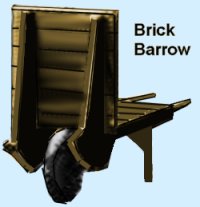
Sketch showing typical wooden brick barrow


The bricks were stacked (and often moved) by hand until the later 1950's so a brick works with a rail connection would feature a loading bank to make loading the wagons easier. Where the works had a Hoffman type kiln the siding often ran alongside this so the bricks could be transferred directly from the kiln onto wagons, but even here there would be piles of bricks waiting to be sent out. The brick works were early adopters of the fork-lift truck and the wooden pallet. By the 1960's over half the bricks being despatched were palletised and the brick companies were the first to fit hydraulic cranes onto lorries to handle the pallets.

Bricks are remarkably useful building blocks, however when the railways were built, with their long viaducts, it was found that conventional fired clay bricks could not handle the vibration caused by the trains. The solution was the 'engineering brick', made by compressing the clay to avoid any small air pockets inside the brick, these were then fired at a higher temperature. These 'blue' engineering bricks are largely made in Staffordshire, and there is a national market for such bricks because of their load bearing, low porosity and other characteristics. The demand from the railways in particular saw the rapid development of 'engineering brick'.

In the later 19th century a new approach called the 'semi-dry' brick was developed, early attempts at using this approach in Nottingham were a failure as the bricks soon crumbled and it was found that a considerable pressure was required in forming the bricks. Toward the end of the 19th century this semi-dry method found a home in the area of Northamptonshire around Peterborough resulting the production of the famous 'fletton brick'.

The surface clays in the area around Peterborough had been used for brick making but the results had been poor, at a town called Fletton the semi-dry method coupled with the particularly pure and rather dry Oxford clays found 30 feet or more below the surface produced hard, light, square bricks. The lack of water in the shale like clays meant little if any drying was required, saving on fuel, and the industry thrived. Similar clays are found in Bedfordshire, Buckinghamshire and Lincolnshire and all these deposits supported a thriving 'fletton brick' industry. In some clay deposits there was something organic and combustible in the clay itself, which further reduced the costs. Where the clay did not have this ingredient they added some powdered coal. There are problems with fletton bricks however, the nature of the clay means they cannot be set by machine, nor can they be fired in a modern continuous kiln (the older Hoffman type had to be used) and the bricks themselves do not stand up to weathering well (they are fine for brickwork on the inner walls of a building).

The semi-dry method was taken up in Accrington with more success and Accrington engineering brick, made from the local shales, is very hard indeed (special tips are required on drill bits when putting up shelving on walls of Accrington brick). Since the end of World War One the particularly hard brick produced using the semi-dry method have found a use for paving roads, these are the hardest bricks made.

The standard British brick is some nine inches by four and a half inches and between 2 and three inches thick. There are four basic categories of brick: Fletton bricks (flettons) are bricks made from the lower Oxford clay, they type is named after Fletton, near Peterborough. Common bricks are suitable for general building work but have no special claim to an attractive appearance. Facing bricks are bricks specially made or selected to give an attractive appearance without rendering or plastering. Engineering bricks are bricks having a dense and strong semi-vitreous body conforming to defined limits for absorption and strength. No fletton bricks are of 'engineering' quality.

Decorative bricks are produced in colours determined by the nature of the clay used and temperature of firing, for example a lot of iron in the clay gives red, clay with very little iron produces a hard blue brick whilst brown and yellow are produced by adding lime (or chalk) and magnesia. By controlling the supply of air during firing a blue brick can be produced which is not the hard 'engineering' type. Bricks can have a glaze added to what will be the outer face, although this does add to the cost. To make a waterproof glaze for water pipes (also seen on bricks) they used salt, so you can justify a Peco salt wagon or two.

A more expensive type of glaze was used to make the white faced bricks used to spell out the company name when building industrial structures such as factories and chimneys. I have heard that these were actually 'white' bricks (as in the colour is right through the brick) but I am not sure about that, it could be an enamel coating on the face of the bricks.


Modelling a brick works

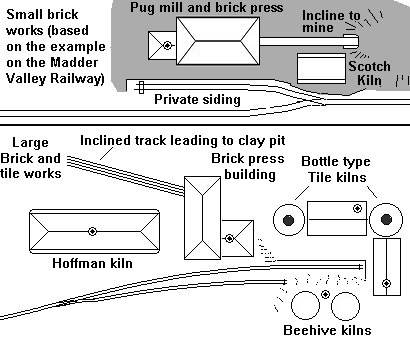
Modelling a brick works is not difficult and they can be scaled to suit almost any available space. The smallest convincing model brick works I have seen is on John Ahern's famous Madder Valley Railway (preserved at Pendon Museum). This little establishment was described in the December 1954 edition of Model Railway News. Modelled in British N this works would require a space about ten inches by four inches yet it has all the necessary buildings and ancillary structures. The clay on this layout is recovered from a drift mine, feeding the upper floor of the pug mill via an incline (examples of this existed into the 50s possibly later). The pug mill building also houses the brick forming machinery and close by is a small coal fired 'scotch kiln'. The sketch below shows a rather condensed version, adding to the main structures and having some more buildings would be preferable if space allows. Not shown is the mess, the piles of coal and piles of broken and discarded bricks, the remains of worn out delivery lorries and heft lumps of ironmongery from worn out equipment. Brickworks were not the most tidy of establishments.

Fig ___ Small brick works
Sketch showing minimum space small brick works

Most brick works used an open clay pit anything up to 100 feet deep, which is too big to include on a model. However they may have piled up the top soil when they started, and they used narrow gauge lines to transport the clay from the pit to the works. Hence you can arrange for the line to emerge from behind an embankment on the edge of the 'pit' (set to the rear of the layout). The drift mine type is an alternative, as noted above examples remained in use into the 1950s if not later.


The early pug mills were sometimes powered by a nearby horse gin, the pug mill building being a small round structure about as tall as a small cottage. A slightly larger mill, using a steam (or later electric) pug mill would be a two storey building, typically the tipper wagons entered the mill building via a rather steep incline (possibly rope-hauled). These buildings were (from what I have seen) generally small and all rather 'rustic', with no architectural embellishments (the customers were not likely to visit and if they did they would not be interested in the factory itself). The immediate area was generally quite overgrown, at least at the smaller works. The clay from the pug mill was fed by gravity to the ground floor brick forming machine (or pipe extruder) and in most cases there would then be a drying shed close by, these tended to be rather large, several times the floor area of the pug mill building, but for modelling purposes a single rather small shed will suffice. Not all clays require drying but most did and but for modelling purposes this shed can be an extension to the mill and press building to save space.

Fig ___ Typical small brick and tile works buildings
Sketch showing small brick and tile works buildings

To add more interest you can 'extend' the drying shed in a slightly different style, have a disused beehive type kiln partly overgrown and add an outside loo.

The kilns can be made in various ways, for example (in N) a ping-pong ball (cut in half) is just big enough to make a rather small 'bee-hive' kiln, I used cut down 'party poppers to make some of these. For a tunnel kiln I used a section of a sweetener dispenser tube which had a flat on one side for the base that made the modelling easier.

The Pola (now Faller) 'OO' kit range includes a 'brick works' kiln of the Hoffman type, although based on a German original it resembles a local old brick works as I remember it and the catalogue illustration could be used as a guide for building your own. There was a lot of variation in Hoffman kilns, on some the structure on the top extended out over the sides, supported on steel girders (I have no idea why this was done).

Given a little room the works can be made quite extensive, justifying regular rail shipments including modern freightliner type operations for half height containers of palletised bricks. The very rough sketch below shows the track plan (from an aerial photo dated 1924) of a typical brick works and gives some idea of the scale of the operation, there were actually two clay pits, each of which occupied as much space again. The loading bank had many neat rectangular piles of bricks, each about a wagon load in size (that is about the size of an insert for a five plank wagon but standing on one side).

Fig ___ Rough sketch of a large brick and tile works in the 1920s
Sketch showing typical larger brick and tile works with the associated railwar sidings

Not all brick works were so extensive, there were quite a few which featured a single Hoffman type kiln or a collection of perhaps four beehive kilns with a single railway siding running close by at a loading bank. If space is tight the clay pit, pug mill and drying sheds can be off the baseboard, with just a single siding serving a loading bank run along a kiln or set of kilns. One prototype example on the Chester to Hollyhead line was such an arrangement, the single siding was about 150 yards long from the gated entry to the works property to the buffers, the Hoffman kiln used was about 50 yards long and about 10 yards wide. If space is really tight the Hoffman kiln is big enough to be modelled in half-relief against the back scene. If required the narrow gauge lines can be represented using Z gauge track, although this is a bit on the large side it is easy to work with. In the example below I have added a couple of smaller kilns, which might be of interest if you like making buildings.

Fig ___ Larger brick and tile works
Sketch showing typical medium sized brick and tile works

At a larger works the associated buildings would also be larger, the illustration below shows the Etna brick works at Armadale in Scotland shortly before it closed down. The tall building is connected by a conveyor belt (angled down to the right) from the clay pit.

Fig ___ Larger brick works mill and press buildings
Photo of buildings at a large brick and tile works

A modern linear kiln can consist of over 150 different chambers through which the bricks pass on metal trolleys. As one lot of bricks were removed from one end another lot were being wheeled in at the other. The heated air from the cooling bricks at the output end is fed into the earlier stages to pre-heat the bricks passing through. These are all housed in large corrugated iron structures. A typical kiln might be 30 or 50 yards long, often these were semicircular in section. A simple representation of an early linear kiln set up in the open can be produced using a length of half round section wood, perhaps 20 mm across the flat, with a covering of brick paper and plasticard doors added at either end. There would be a small square structures with chimneys at intervals along the side where the fires were set, these would house the controls for the gas burners, coal firing would be unlikely). By the later 1950s these were often housed in large corrugated metal sheds, by the 1970s these sheds used the large curved sections of corrugated sheeting and had sections such as supporting columns and window frames painted in strong colours (red and blue being common).

Incoming materials would include wagon loads of coal with coke and possibly oil for an on-site 'producer gas' plant. If the site has a Hoffman kiln you can run sheeted or roofed coal wagons carrying pulverised coal (called 'duff' by the mines but 'smudge' or sometimes 'clinker' by the brick works), sand wagons (the sand was added to the mix for bricks) and salt wagons (for glazed water pipes or 'facing' bricks.

Outgoing would be wagon loads of bricks, red house bricks or blue engineering brick, generally these would come from separate factories. The Staffordshire Blue was a common high quality engineering brick, made using a dense clay mix 'burnt' at a high temperature. These were often used by the railway companies (especially for inner rings on bridge arches and for retaining walls).

Clutter would include a lot of broken bricks in heaps as well as piles of bricks ready to be shipped out, a coal heap by the boiler house (and of course by the kilns) and a couple of side-tipping wagons (sometimes seen lying on their side beside the railway to the pit presumably awaiting repair). The examples shown below are the side tipper type (top row) and a coal tub and brick wagon (bottom row).

Fig ___ Typical narrow gauge wagons for a brick works
Sketch showing narrow gauge wagons for a brick works


Up to the end of the 1970s the bricks were stacked in the open railway wagons by hand, men throwing them to each other two at a time (note they would always be wearing thick gloves for this work). Since the second world war bricks have generally changed over to palletised loads, a working drawing showing the production of an early BR wagon (Palbrick B) is to be found in the section on kit bashing. The introduction of the associated fork lift trucks in the later 1960s saw a major change in the scene at the works.

Fig ___ Sketch of a 1970s fork lift in a brick and tile works
Sketch of a 1970s fork lift in a brick and tile works

A very small brick or tile works might have a railway siding well into the 1960s, a few may have survived into the mid 1970s, but most of these works supplied only local demand.

A lot of bricks were delivered by road to local clients, in the post war era road haulage became increasingly common for longer hauls although rail transport was common into the 1960s. The development of the pallet was matched by the use of pallet wagons and when the Freightliner services started up LBC developed the 'fletliner' system. By the mid 1970s about 10 per cent of LBCs deliveries were made via nine railhead depots including those served by the 'fletliner' system. This system enables bricks to be mechanically loaded, alongside the kilns, into skeletal containers which are transferred, at the distant rail terminal, to special lorries for mechanical unloading at the building site.

LBC calculated that the 'fletliner' system can normally be profitable, as compared with direct road haulage, if (a) depots are at least 100 radial miles from the supplying works, (b) they serve catchment areas with a regular demand of 1-6 million bricks (ie 5 train loads) a week, and (c) a single works, or a group of works in close proximity, can supply the quantity and range of bricks required. The fletliners were first used on a service to Liverpool and Manchester (started in 1973), followed by a London service in 1974 (a short haul but preferable to road due to congestion problems) and one to the North East, started (I think) in about 1976. By this time LBC were reliant on road haulage contractors to deliver about half their bricks, the remaining ten percent being delivered using their own lorries (only about 1 percent was collected by the customer in their lorries).

By the mid 1980 the railways referred to these container wagon services as 'brickliner', presumably as other firms were also using them.


Other products of a 'brick' works - Tiles and pipes

Also produced at many brick works (and staple production at many smaller works) were clay tiles for roofing, chimney pots, flooring and (glazed) tiles for wall decoration as well as salt-glazed pipes for drainage and 'fire clay' pipes for underground electrical conduits. Clay pipes were formed by placing a block of clay into a machine which then extruded the pipes, these were stacked to dry on shelves in the drying shed before being fired.

These products were all less robust than bricks and the railways offered shock-absorbing wagons to try and retain this trade, which was transferring to road by the late 1930's.

In the limited information I have managed to find on this side of the business it would appear that bottle and beehive kilns were regularly used for firing the tiles pipes and decorative items. These kilns are discussed in more detail under 'Lineside Industries - Prototype industrial ancillary structures - Kilns'.

The tiles were (usually) a fairly dark red colour, typically about nine inches to a foot square and about a quarter inch thick (in the 1950s there seem to have been more small tiles produced, say six inches square). As well as the flat tiles there would also be curved and V shaped ridge tiles produced at the works. The tiles were stacked on edge in tapering piles perhaps five feet high by about five tiles deep from front to back and about ten feet long at the base. The ridge tiles were stacked one atop the other, perhaps ten high, in small groups (you need a lot more of the flat type compared to the ridge type).

Stacks of tiles can me modelled (in N) using strips of 10 thou card about 2mm wide, cut into 8-10mm lengths. Once the main body of the stack is assembled add a few individual tiles to the outer ends (cutting these carefully to 2mm lengths). The ridge tiles can be cut from small diameter straw (not easy) or fold a strip of paper, cut this down to for a V shaped strip about 1.5mm to each side and glue these on top of each other. Making these stacks is a bit tedious but the resulting piles add a lot of authenticity to the scene.

A lot of tile works were taken over by the government in World War Two, using the drying sheds and kilns for storage of military and civilian supplies. After the war the Staffordshire industry, once important with many small works dotted about the place, never recovered. They had to use mined clay and they could not compete with clay tiles from other areas and from the increasingly common concrete roofing tiles (see also 'Lineside Industries - Cement manufacture and distribution', the discussion on concrete block and roofing products is at the end of that page). By the later 1960s the clay tile, and the good but expensive slate roofing, was becoming increasingly rare as the cheaper concrete tiles from the likes of Marley and Redland came to dominate the domestic roofing market.

Pipes were made in all forms of kiln, at larger works they used their Hoffman kilns for these as well as bricks. To make water proofed pipes for drainage and the like they glazed them using salt. Pipes used for electrical conduiting were made from 'fire clay' and often a light or rather dark grey colour. For all types of pipe the best option is to buy packets of 'bugle beads' from you local dress making shop (if you have a Singer shop nearby they generally carry a good range of beads and trimmings). Cutting a lot of sections of tube to length is (for me anyway) difficult to achieve. A lot of pipes were simple straight lengths but those used for drainage usually had a flared end to allow them to be joined in a row (cement was added to fill the joint). This can be added using a strip of paper (for bugle beads) or Slaters Microstrip (for plastic tubes. The drainage pipes I remember from the post war building boom were about eight or ten inches in diameter (the smaller ones going to individual homes and hence more common) and quite short (just under three feet long). They were a dark cream colour on the inside and slightly darker on the outside surface (a light chocolate colour).

Smaller pipes would be stacked perhaps five feet high (they were generally man-handled prior to the 1970s), larger pipes (cut from straws in N) would often be seen stacked only two rows high.

Fig ___ Stack of ridge tiles and pipes stacked with wooden cradles
Stack of ridge tiles and pipes stacked with wooden cradles


Brick companies

In 1938, there were 1,147 brickworks in Great Britain which produced 6,939 million bricks, virtually all of them from clay. In 1969 there were 544 works, which between them produced 6,734 million bricks. In 1973 there were 357 works which between them made 7,183 million bricks (rather more bricks were produced than in 1938 but the number of brickworks had fallen to less than one-third). By the 1970s fletton bricks accounted for nearly half of the total brick deliveries. By this time there were about 150 brick companies, of which about 120 made clay bricks (23 making flettons, these were the largest works and by the later 1970s the London Brick Company had become the sole producer of such bricks), about 15 made calcium silicate bricks and about 20 made concrete bricks. By the mid 1980s there were about 30 separate large firms producing bricks and a number of smaller concerns (mainly providing specialised products such as decorative tiles). By this time however five major companies were supplying about 90 percent of all bricks used in the UK. These were London Brick Co, Steetly Brick Co, Ibstock Building Products Ltd, Butterley Building Materials Ltd and Redland Bricks Ltd. Only London Brick Co were producing fletton type bricks by this time (as they had taken over all their competitors). The remaining four companies produced only non-fletton bricks.

Other important non-fletton producers included Westbrick Ltd (C H Beezer (Holdings) Ltd), Scottish Brick Corporation Ltd (National Coal Board and Aurora Holdings PLC), Bowater Crossley Bricks Ltd (Bowater Corporation PLC), J and A Jackson Ltd (Christian Salvesen) and Nottingham Brick PLC.

Few, if any, manufacturers were content to rely solely on merchants and 'brick factors' to promote their product. Having said which by the 1970s at least 60 per cent of all bricks delivered were channelled through merchants or factors. The brick makers could do little to influence demand, the price of the bricks constitutes only about 2-3 per cent of the price of a house, so they were subject to the fluctuations in the market. By the 1970s the standard practice in industry was to own as little as possible, borrowing money for production from the banks in the expectation of making enough profit for the firm as well as repaying the loans, as a result a lot of firms failed in the recession of the 1970s when demand slumped for several years. The fuel for the kilns contributes about 30 percent of the running costs, if production is slowed the same amount of fuel has to be used to keep the kilns up to the required temperature (slowing down the brick making results in poor quality bricks). If a brick works stops production the plant deteriorates and the start-up costs are often prohibitive (without a large order to carry the firm through this period). Concrete and silicate brick makers do not have the kilns to operate and generally fare better during a down turn although these days the shortage of skilled works means that when production picks up they generally have to start training new staff.

One option is to build up a stock of bricks so the plant can be shut down for a time, stockholding involves a once-off cost for providing hard-standing for the bricks and extra handling costs. This may be limited by lack of lad at the works on which to build up the stock pile. To protect the pile it was piled with straw and roofed over, often with corrugated iron sheeting, even so depending on the type of brick the stockpile can deteriorate over time. In the mid 1970s there was consideration given to a public financed 'brick bank' system, to allow for continuous employment at the brick works and iron out the damaging effects of fluctuations in demand. This was not however pursued.


London Brick Company (LBC)
The largest UK brick maker was for many years the London Brick Company, incorporated in 1900 (some 20 years after a method of manufacturing Fletton brick was developed). LBC not only made bricks and clay pipes but also sold machinery and equipment for brick production and handling. Before the first world war, the market for fletton bricks was restricted to the London area, parts of the East Midlands and East Anglia. From the later 1920s LBC began offering their bricks for sale nation wide, by-passing the local brick factors, and by the 1950s they were used throughout England and Wales and were starting to be seen in Scotland. At this time the London Brick Co supplied about 70 per cent of fletton deliveries and about 24 per cent of total brick deliveries.

In the mid 1960s LBC had four competitors in fletton brickmaking; Marston Valley Brick Company Limited (representing about 14 per cent of fletton deliveries), Redland Limited (about 8 percent), Whittlesea Central Brick Company Limited (about 4 per cent) and Flettons Limited (about 2 per cent). Flettons Limited ceased production in 1970. LBC acquired Marston Valley in 1968, Redland's fletton works in 1971, and Whittlesea's works in 1973. By 1974 LBC was the sole producer of fletton bricks, supplying about 40 per cent of total brick deliveries. At this time LBC was operating 22 works (all but two being pre-war), in the Peterborough, Bedford and Bletchley areas, with a total target capacity of about 3,450 million bricks. Because of the way the fletton bricks have to be stacked in the kilns about half the production had to be lower value 'commons', only the upper layers being suitable as 'facings'.

In 1982 LBC was still the largest single firm, by this time they were trading as London Brick Products Ltd, the major subsidiary company in the London Brick PLC group. In 1984 the Hanson Trust obtained a 50 percent share in the company and took effective control of it. In 2000 the Stewartby plant closed, this being the last brick works in Bedfordshire.

Ibstock Building Products Ltd
The Ibstock company started life in the Leicestershire village of the same name, where a brick works had operated since about 1830. In 1899 a company was registered as Ibstock Collieries Ltd. At the time the principal business was coal mining but they also quarried clay for the manufacture of bricks and pipes (they gave up the coal mining side in 1929). The company became the Ibstock Brick and Tile Company Ltd (IBT) in 1935 and after the Second World War began to specialise in brick production. In 1963, following the acquisition of Himley Brick Company Ltd, IBT became a public quoted company and began a major programme of expansion which was achieved mainly by further acquisition. Ibstock was formed in 1970 by a merger of Ibstock Building Products Ltd (EBP), at that time known as Ibstock Brick and Tile Company Ltd, and Johnsen, Jorgensen and Wettre Ltd (JJW). After the formation of IBP the increased resources of the combined company were used to continue the programme of expansion in brickmaking initiated by IBT in 1963. At the end of 1982 the group had eleven brickworks in the United Kingdom, by which time it was the third largest supplier of bricks in the UK after London Brick and Steetley Brick Ltd, the second largest supplier of facing bricks after London Brick and the largest supplier of non-fletton facing bricks. It had brick making interests in Europe, Scandinavia and the USA and its 'fibres division' was operated by a wholly owned subsidiary, Johnsen, Jorgensen and Wettre Ltd, who sold wood pulp from Scandinavia and the Americas to the paper and board industry both in the UK and Europe. This latter company also sells newsprint and board and has a small wastepaper operation. The brickmaking subsidiary in Holland was sold to Redland in the early 1980s.
In 1990 Ibstock Building Products acquired two new companies; Hathernware Ltd and Ceba Ltd. Hathernware manufactured terracotta and architectural faience and Ceba manufacture architectural wet cast stone. Through continued expansion during the 1990s another three stone factories were added.
At the beginning of its Centennial year, 1999, Ibstock joined the CRH Group and the stone factories were transferred to Forticrete, a sister company in CRH and the Ibstock Group was formed of Ibstock Brick Ltd and Forticrete Ltd.
In 2003, the Company changed to Ibstock – Innovators in Clay. Ibstock Ltd in 2008 has 24 brick and paver plants with a total annual capacity in excess of 900 million bricks. The Company employs a total of 1960 people across the UK and has the backing of one of the worlds largest building materials companies.
Ibstock's brick making works are based mainly in the Midlands, its market shares are highest there and in East Anglia but it also has plants in Lancashire, Avon, Yorkshire and the South-East.

Steetly Brick Co
Steetley PLC (Steetley) originated in a company formed in the 1880s to operate a quarry at Steetley in Nottinghamshire In 1885 the quarry traded as The Steetley Lime and Building Stone Company supplying mainly hard-burnt lime.
Mixed in with the limestone was dolomite, a sedimentary rock, pale pink in colour, related to limestone but containing magnesia and formed into crystals. If it is burnt in a kiln (as for limestone to make lime) it can be used both as a heat resistant 'refractory' product in granular form (to repair linings and for making the bricks used in the refractory linings of casting ladles and cement kilns. They soon built a continuous shaft kiln to produce Doloma, the actual kiln was a vertical shaft, lined with tarred, burnt dolomite. Stone and coke were fed into the top of this air-blown furnace and Doloma emerged at the bottom. The demand for Doloma expanded rapidly, influencing Steetley to look for sources of raw material in other parts of the country.
This work, making 'refractory materials', continued to be their core business although over the years they went into the brick making side as well. Increasing demand led to the acquisition in 1904 of another quarry at Coxhoe in Co Durham and to the installation of the first vertical shaft kiln there in 1906. Demand was further accelerated by the First World War. In 1921 the Taffs Well quarry in South Wales was acquired, and by 1923 output had reached 150,000 tons per annum. Growth continued in the 1920s and by 1930 there were four operating companies which were then amalgamated to form the Steetley Lime and Basic Company Limited (name changed in 1944 to The Steetley Company Limited and in 1982 to Steetley PLC).
In 1937 a pilot plant to extract magnesia from dolomitic lime (to reduce dependence on imports) was built and in l938 a full production plant was on stream, just in time to aid the war effort, the product being marketed as Britmag. This eventually led to the opening of the Refractory Brick Company of England, making Dolofer bricks.
Steetley expanded its activities beyond dolomite and magnesia-based refractories into silica, taking over the Oughtibridge Silica Firebrick Company in 1947. Dolomite activities were extended outside the UK and in 1952 Steetley acquired the Canada Crushed and Cut Stone Company, which had dolomite deposits in the Niagara Fails area.
Further diversification took Steetley into the ready-mixed concrete business in 1964 and into the techniques of sand and gravel extraction, which were in direct contrast to hard rock quarrying. Improved technology in steel making, especially the 'basic oxygen process' led to a requirement for high purity calcium lime. Thus, in 1968, the company acquired a limestone quarry at Dowlow, Derbyshire. Steetley's next major move was into chemicals in 1970; this also expanded the operations overseas in Australia, France, Spain, Saudi Arabia and eventually in the USA.
The company was reorganised into six main operating divisions covering construction materials, facing bricks and clay tiles, minerals, refractories, chemicals and distribution, engineering and properties. Each area of activity is the responsibility of a subsidiary company.
This firm was bought out by Redland in 1992, as part of the deal the Office of Fair Trading required Redland to sell on Steetley's clay roofing tile business and the Cranleigh and Tilmanstone brick plants

Butterley Building Materials Ltd
In 1790 Jessop founded, jointly with partners Benjamin Outram, Francis Beresford and John Wright, the Butterley Iron Works in Derbyshire to manufacture (amongst other things) cast-iron edge rails – a design Jessop had used successfully on a horse-drawn railway scheme for coal wagons between Nanpantan and Loughborough, Leicestershire (1789). Outram was concerned with the production of ironwork and equipment for Jessop’s engineering projects. The Butterley Company was formed in 1807 from the business known as Benjamin Outram and Company. The business became a great success and in 1862 there were seven furnaces at Butterley and Codnor Park. Although the production of ironstone declined locally, the Company still remained a major force in the iron industry. In the late 19th century they became involved in the expansion of the railway industry by manufacturing track and wagons. The Company set up and owned several mines in the East Midlands coalfield and by the late 19th century they were one of the major coal mining enterprises in the country. All the collieries were lost following the Coal Nationalisation Act of 1946. It was then necessary for the Company to diversify. Having taken over several companies, Butterley expanded into the areas of civil engineering and brick-making. In 1957, a partnership with Air Products of the USA helped establish that company in the United Kingdom. In 1968 Butterley was taken over by the Wilks Group, later known as Hanson plc. and the company was subsequently split up into Butterley Engineering, Butterley Brick and Butterley Aggregates. Several other businesses were taken over by Hansons and run by Butterley Building Materials. The name of the whole brick enterprise became Butterley Brick Co. Ltd. in 1985.

Redland Bricks Ltd. Redland originated as Redhill Tile Company in 1919, making concrete roofing tiles (for more on this side of the business see also 'Lineside Industries - Cement and Concrete Manufacture and Distribution').
In 1997 Redland was bought out by LaFarge. In 2003 Redland Roofing Systems changes its name to Lafarge Roofing. In 2007 Lafarge sold Lafarge Roofing to PAI Partners, maintaining a 35% stake in the business. In 2008 Lafarge Roofing became Monier Ltd. but the Redland brand was re-introduced in the UK.

Accrington Brick & Tile Co finally owned by Hanson Building Products
The famous Nori brick has been manufactured in Accrington since 1887 but formed just a small part of the Huncoat plant’s brick production. The bricks manufacturers used to be known as the Iron Brick Company – Nori is iron spelled backwards. Two main theories exist as to why it came to be known as such. One is that the word "Iron" was painted on the factory chimney with the "I" at the bottom and the "N" at the top. Others believe the mould was put on the brick the wrong way round. The red super-strength brick, used to build the foundations of the Empire State Building and Blackpool Tower, it is unique to the area because of its special clay. The company was taken over by Marshalls Clay Products Ltd. (I think in the 1980s) and after 2005 they ended up owned by Hanson Building Products who used the Nori name for a range of acid resistant building products. The works closed in late 2008 (by which time Hanson Building Products was a subsidiary of the multi-national Heidelberg Cement group).

Marshalls Clay Products Ltd.
This company has (or had) offices in both Yorkshire and Scotland and at one time they owned the Acccrington Brick Co. I believe they were taken over by Hanson Trust in the 2005.

Bursledon Brickworks
Based at Swanwick, nr Southampton this firm was founded in 1897 by the Ashby family to replace a works they had originally owned at Chandlers Ford. In 1959 they were making some 2 million bricks a year but the company was taken over by Redlands Brick and Tile Co (later Redlands plc)and in 1974 the works closed.

Stourbridge Brick Company Ltd.
Bought out by Redlands in the 1970s

Samuel Wilkinson Ltd.
Based at Calder in Yorkshire this firm was bought out by Butterley in the 1970s.

G H Downing and Co Ltd.
This firm was bought out by Steetley in the 1970s.


^
Go to top of page