|
Return to Appendix One Index
|



|
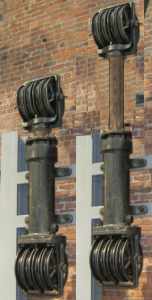
| On the Hydraulic multiplier or 'jigger' the pulley system amplified the distance the lifting rope moved for a given movement of the piston, this also meant that the load moved up or down a lot faster than the piston. There were occasions where rapid loading and unloading was an advantage, a good example being a canal, river or sea wharf, and hydraulic hoists and cranes were common in these applications. They were also common on warehouses, usually mounted near the top of the building and providing access to a series of opening ranged up the building for each floor. |
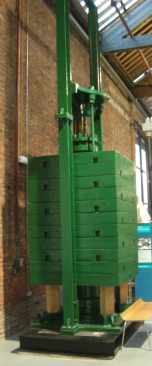
| Mains pressure was rather low and was often not available in docks areas so Armstrong invented a water storage tower, called an 'accumulator' in 1850. This consisted of a tall tower containing a water tank with a weighted piston mounted at the top. The water was pumped up the tower using a water wheel or steam driven pump and the weight on the piston provided the pressure and made the practical use of various forms of hydraulic engine possible. These towers were often the tallest structure around, usually brick built and square in form with a slightly bulbous top section reminiscent of a very tall clock tower but without the clock. |

|
Hydraulic power proved effective and in several cities a system of high pressure hydraulic mains were installed, allowing warehouses and factories to employ jigger-driven hoists without having to build the accumulator and provide an engine to pump it up. The example shown is on a small former garment factory on a side street in Manchester which (I believe) employed the hydraulic mains to power a jigger for their external lifting arrangement (the 'cat head' at the top has since been removed). Built to lift bolts of cloth the doors are only two feet six inches wide.
One odd option that found favour with several smaller firms was to pay for the hydraulic connection and use this to drive a water-wheel driven generator for electricity supply. Apparently this was often a more reliable supply than the available electrical mains. |
